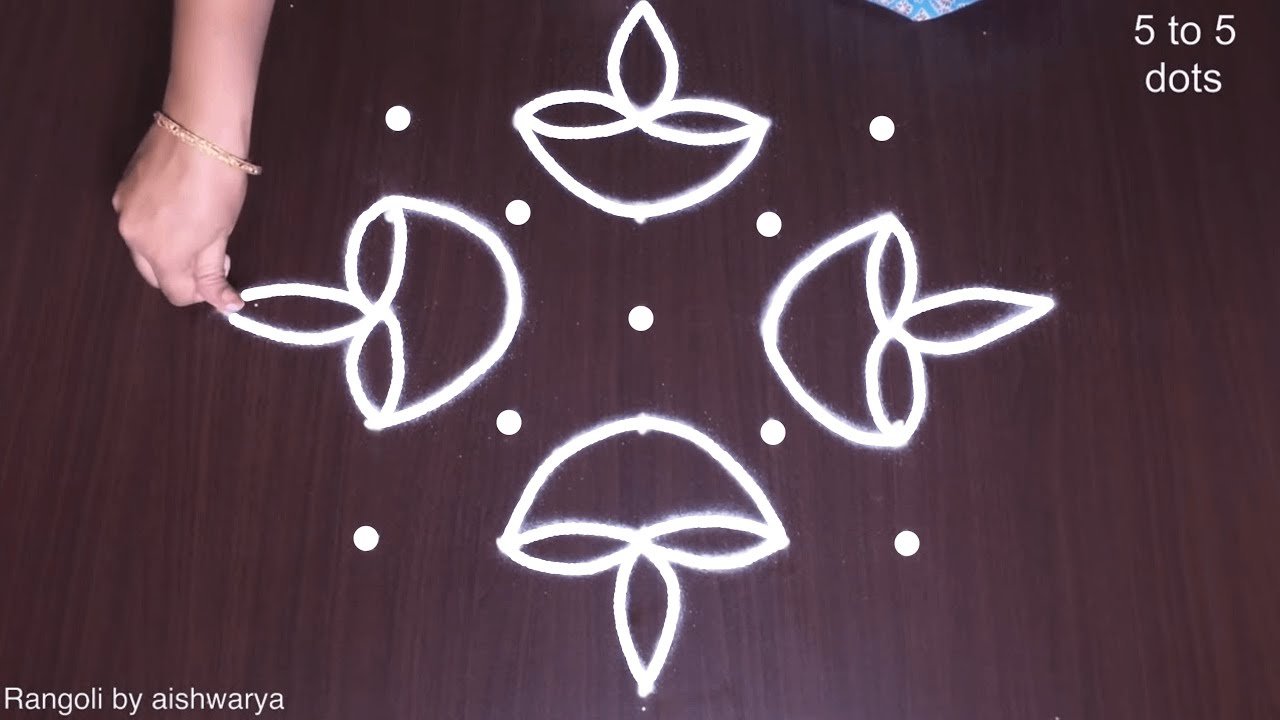
Definition
The sun motif — surya — is a central disc surrounded by evenly spaced rays: radial symmetry in its most elemental form. It appears as a design’s focal centre, as a repeated border unit, and as the organising figure of harvest-season compositions, and it is among the easiest natural motifs to construct geometrically — a circle, a count of rays, rotational balance, done.
The rays are where the variation lives: straight lines, curved flames, triangles, lotus petals, alternating long-and-short patterns. Regional and personal styles choose differently; the disc-and-rays identity survives every choice, which is exactly the property a universal symbol needs.
History
Solar imagery is among the oldest continuous threads in the subcontinent’s art — rock art, early coins, temple carving, bronze icons, manuscripts, astronomical diagrams — and it rises to architecture’s front rank in the sun temples: Konark’s thirteenth-century stone chariot with its carved wheels, and the earlier solar shrines at Modhera and Martand. The same figure a household draws in a minute at its threshold stands, in stone, among the most ambitious monuments of Indian civilisation.
That continuity has a practical root: before mechanical time, the sun was the clock and the calendar. Its daily path set working hours and ceremonial timings; its yearly path set planting and harvest. A figure that governed time itself was never going to stay out of the decorative record.
Description
Compositionally the sun is the ideal focal point, and artists use it as one: the circular centre anchors, the rays direct the eye outward along every axis at once, and the whole figure sits naturally at the heart of concentric borders. Drawn on a dot grid the rays fall on counted points; drawn freehand they are spaced by eye — either way the discipline is even spacing, since a single crowded ray breaks the balance the motif exists to display.
The standard repertoire includes the radiant sun (plain disc and rays), the floral sun (rays formed of petals, blurring sun into lotus), the geometric sun (built entirely of circles and triangles), festival suns joined with harvest imagery, and solar borders — the ray pattern repeated as a running frame. In large compositions the sun frequently shares the field with its complement, the crescent moon.
Cultural Context
The sun’s attributed meanings need little decoding, because they restate its observable role: life, vitality, constancy, renewal — the powers a sun actually exercises over crops, seasons, and days, translated into symbol. To these the philosophical register adds light-as-knowledge (shared with the lamp) and the moral reading of the sun’s reliability: it rises for everyone, every day, and its punctual generosity became an image of discipline and impartial giving. The readings are attributed, as all such readings are; the drawn form is a disc and rays.
In Hindu iconography Surya personifies the star — classically depicted on a radiant chariot drawn by seven horses, bearing lotuses — and the harvest festivals are the motif’s great season: Makara Sankranti and Pongal both mark the sun’s turning, and their rangoli traditions carry solar imagery with harvest pots and sugarcane. A sun drawn in mid-January is as much a calendar entry as a decoration.
The agricultural root explains the emotional register. For farming communities the sun was survival: seasonal light governed planting, ripening, and harvest, and its steady return earned gratitude as much as observation. Harvest-festival rangoli states that gratitude visibly — the solar disc among pots and cane is a thanksgiving in powder — and even the plainest morning sun at a threshold keeps a trace of the same acknowledgement: the day has been given again, and the household marks it.
Regional Variations
The solar motif is universal, with regional accents in the ray treatment: flame-rays and bold colour in the northern and western festival styles, counted-grid suns in southern kolam and muggulu practice, painted discs in the eastern rice-paste arts, and rayed roundels within the ceremonial diagram traditions. Contemporary design keeps the figure in constant service — and has begun lending it a new sense, as environmental campaigns reach for the old symbol to speak about renewable energy: a fresh meaning added without displacing the ancient ones.
Related Topics
The sun’s celestial partner is the Moon; its petal-rayed variant borders on the Lotus; its structural family is the Radial Structure; its festivals are Sankranti and Pongal.
Gallery
References
- Vijaya Nagarajan, Feeding a Thousand Souls: Women, Ritual, and Ecology in India — An Exploration of the Kōlam, Oxford University Press, 2018.
- Jyotsna Kilambi, “Toward an Understanding of the Muggu: Threshold Drawings in Hyderabad”, RES: Anthropology and Aesthetics 10, 1985.
Further Reading
- Marcia Ascher, Mathematics Elsewhere: An Exploration of Ideas Across Cultures, Princeton University Press, 2002.
This entry publishes at Evidence Level E2: its claims rest on at least two independently verified sources.
Cite this entry: “Sun.” Rangoli Encyclopedia, Rangoli Designs, https://rangolidesigns.net/encyclopedia/sun/ — a permanent URL under the encyclopedia’s stable-identity policy. Entry last reviewed 2026-07-28.