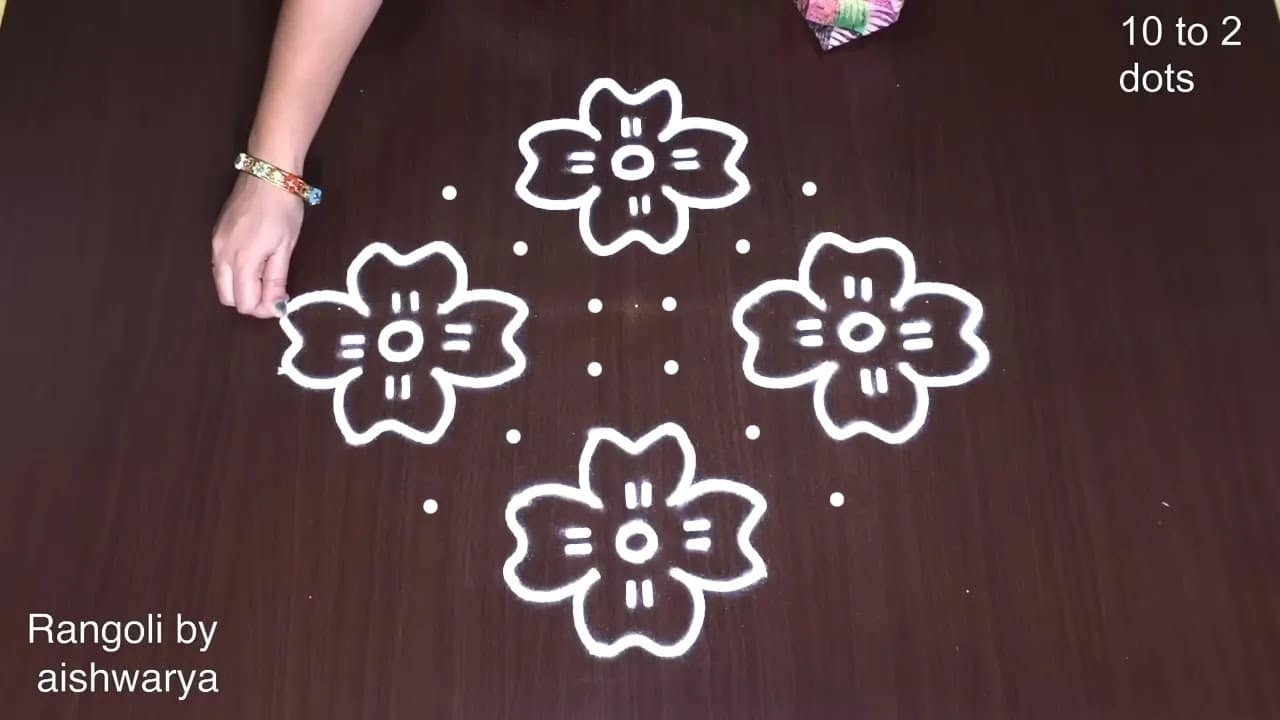
A rangoli can be admired as decoration, read as geometry, and studied as heritage — and it is fully understood only as all three at once. The tradition sits at an intersection: drawn by the hand, organised by the mind, sustained by culture.
An artist’s discipline without an artist’s tools
Every design begins with the decisions any composer of images faces — scale, proportion, rhythm, balance, emphasis — but rangoli makes them without brushes, rulers, or the forgiving distance of paper. Powder flows between finger and thumb directly onto the ground; every movement is immediately final. The practitioner’s instruments are finger control, visual estimation, and accumulated bodily memory — which is why the drawn line carries a fluid character that mechanical reproduction struggles to match.
The geometry beneath the beauty
Beneath the ornament, many designs are rigorously organised. Reflection, rotation, and radial symmetry structure the compositions; borders repeat motifs at measured intervals; and in the southern traditions the dot grid supplies an invisible architecture — a counted scaffold the finished design conceals, as a building conceals its frame. The Siromoneys showed in the 1970s that whole kolam families could be generated by formal array grammars, and later scholarship — Ascher’s ethnomathematics, Yanagisawa and Nagata’s design-system analyses — connected the interlaced families to knot diagrams and single-stroke path problems. None of this claims the historical practitioners applied modern theory; it demonstrates the reverse and more remarkable fact, that long artistic practice arrived at structures mathematics would later name.
Learning without textbooks
The tradition’s transmission is its own pedagogy. Children acquire counting, spacing, symmetry, and spatial memory by watching, copying, and repeating — mathematics absorbed through the hand years before it is met in a classroom. Educators increasingly recognise the value of this embodied route into pattern and proportion, and the kolam’s grids have become teaching material far from the thresholds that invented them.
Heritage that lives by being practised
Cultural heritage is not only monuments; it includes the skills, practices, and knowledge a community keeps alive — what scholars call intangible heritage. Rangoli belongs squarely to that category: its archive is not a museum collection but the practised knowledge of millions of households, renewed every time an elder’s hand guides a younger one through a first border. Preservation here is an activity, not a vault — the tradition survives exactly as long as it is drawn.
References
- Gift Siromoney, Rani Siromoney & Kamala Krithivasan, “Array grammars and kolam”, Computer Graphics and Image Processing 3(1), 1974.
- Marcia Ascher, “The Kolam Tradition”, American Scientist 90(1), 2002.
- Kiwamu Yanagisawa & Shojiro Nagata, “Fundamental Study on Design System of Kolam Pattern”, Forma 22, 2007.
- Vijaya Nagarajan, Feeding a Thousand Souls: Women, Ritual, and Ecology in India — An Exploration of the Kōlam, Oxford University Press, 2018.
Further Reading
- Marcia Ascher, Mathematics Elsewhere: An Exploration of Ideas Across Cultures, Princeton University Press, 2002.
This entry publishes at Evidence Level E2: its claims rest on at least two independently verified sources.
Cite this entry: “Art, Mathematics, and Heritage.” Rangoli Encyclopedia, Rangoli Designs, https://rangolidesigns.net/encyclopedia/art-mathematics-heritage/ — a permanent URL under the encyclopedia’s stable-identity policy. Entry last reviewed 2026-07-28.