Definition
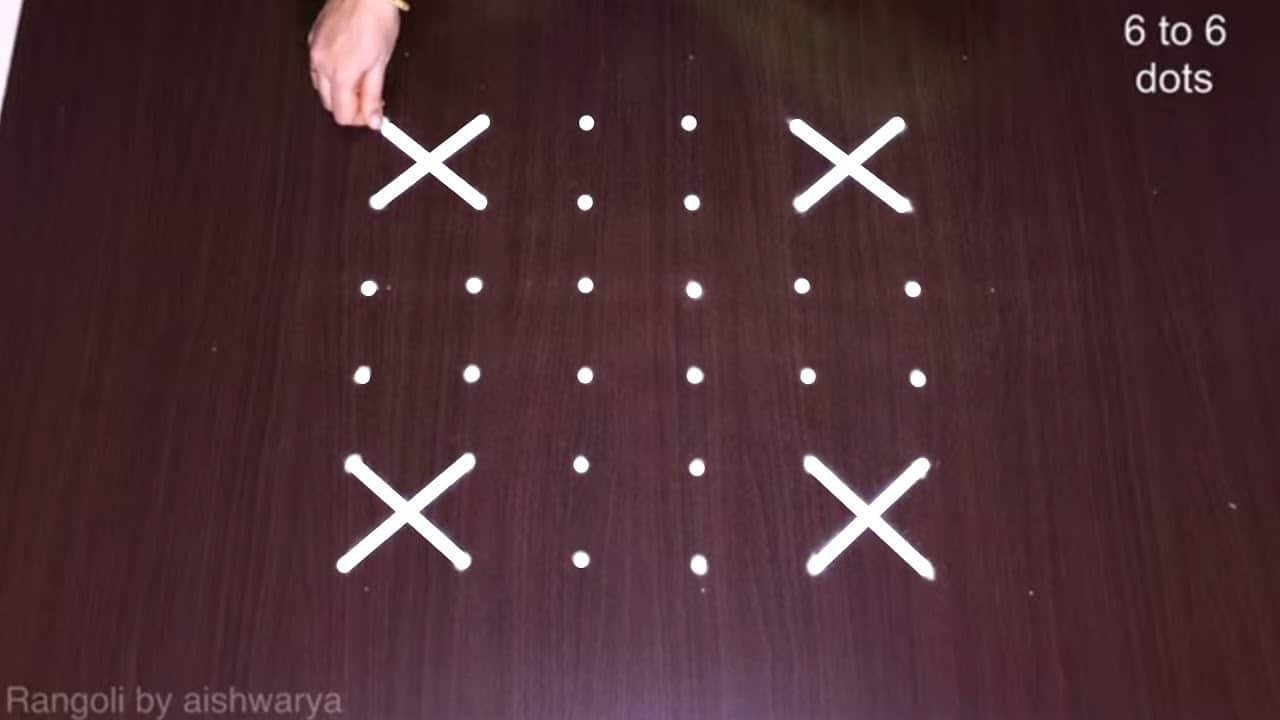
The line structure builds a design from parallel bands, borders, and straight or gently curved strokes rather than from a counted field of dots. It is the structure of threshold borders, of the framing bands that edge larger compositions, and of the quick line kolams — kambi in Tamil usage — drawn when time is short.
History
Line and band work appears throughout the documented repertoires as both a form in its own right and the frame around grid work; the scholarly literature treats it within general kolam practice rather than separately, and this article’s historical claims stay correspondingly brief.
Description
Strokes run parallel to the threshold or doorframe, singly or in rhythmic groups, often finished with hooks, waves, or small motifs at intervals. Line work is the fastest structural mode — a practised hand borders a doorway in moments — and it scales upward as the framing element of elaborate festival pieces.
Cultural Context
Because a simple band can mark a threshold when nothing more is possible, line work is commonly described by practitioners as the practice’s minimum viable form — the sign that the ritual was kept even on the busiest morning. That reading is attributed, and widely voiced.
Regional Variations
Border bands frame doorways in every regional tradition; Tamil practice names its line forms (kambi, “wire” kolam), and red-edged white bands — flour against kavi ochre — are a distinctive Tamil threshold form documented in the ethnography.
Related Topics
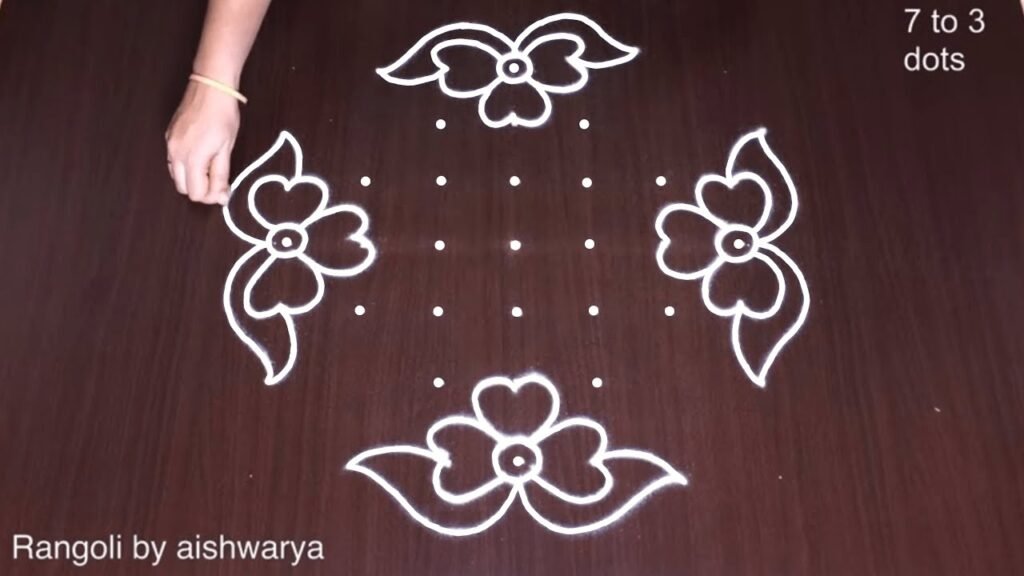
Line work commonly frames Dot Grid compositions; drawn without scaffold it shades into Freehand; sweeping single-line enclosure belongs instead to the Interlaced Structure.
Gallery
References
- Vijaya Nagarajan, Feeding a Thousand Souls: Women, Ritual, and Ecology in India — An Exploration of the Kōlam, Oxford University Press, 2018.
Further Reading
- Marcia Ascher, “The Kolam Tradition”, American Scientist 90(1), 2002.
This entry publishes at Evidence Level E1: common knowledge within the tradition, anchored to a verified standard reference.
Cite this entry: “Line Structure.” Rangoli Encyclopedia, Rangoli Designs, https://rangolidesigns.net/encyclopedia/line-structure/ — a permanent URL under the encyclopedia’s stable-identity policy. Entry last reviewed 2026-07-28.