Definition
Diwali, the autumn festival of lamps, is the occasion on which rangoli reaches its widest geography: across India and the diaspora, thresholds and courtyards receive coloured designs as part of the festival’s preparation of the home, whatever the local drawing tradition is called. It falls on the new-moon night of the lunar month of Kartik (October–November), with observances spread across the surrounding days.
History
The festival’s association with threshold decoration belongs to its broader domestic ritual of cleaning, lighting, and welcoming — documented across the regional ethnographies as the occasion when even households that draw rarely will draw. In much of the north the festival runs as a five-day sequence — from Dhanteras’s purchases to Bhai Dooj’s family visits, with Lakshmi Puja at its centre — and the decorated threshold belongs to the sequence’s logic of the home made ready. In Tamil practice, Deepavali is kept chiefly on the morning of the day itself, with the oil bath before dawn and the threshold drawn early. The kolam-centred scholarship treats Diwali within this general festival practice, and this article’s historical claims stay within that frame.
Description
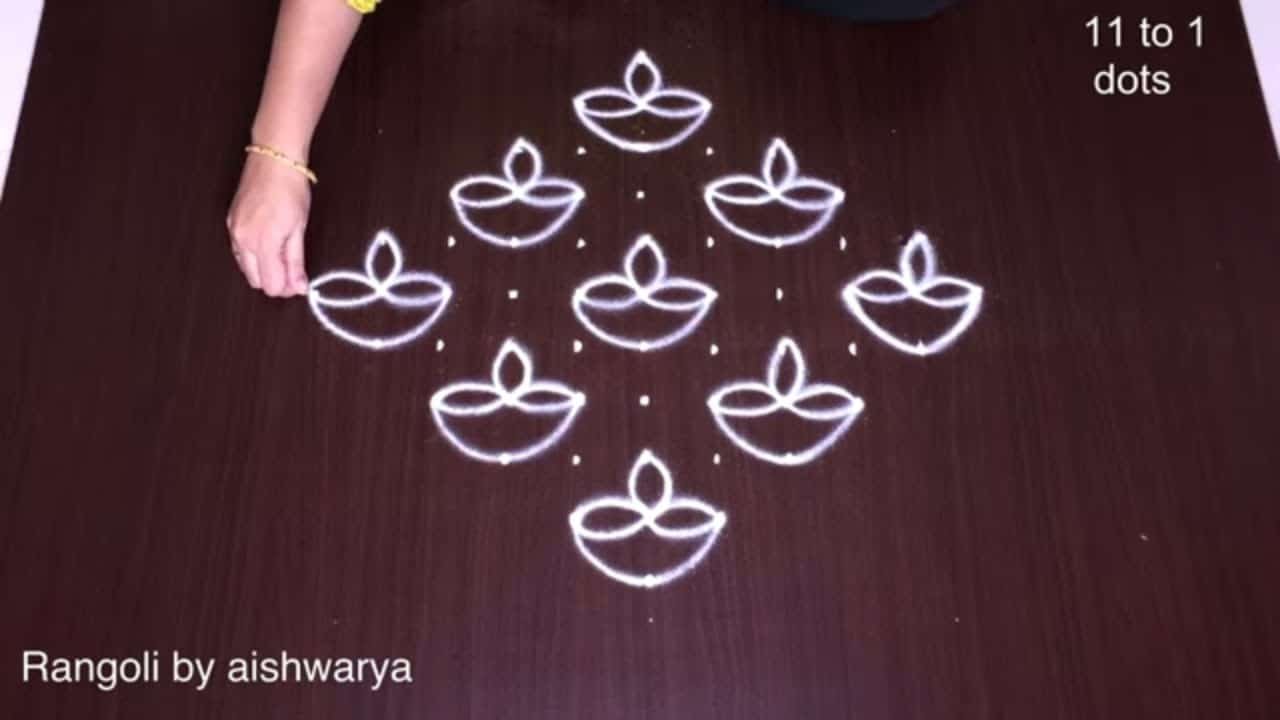
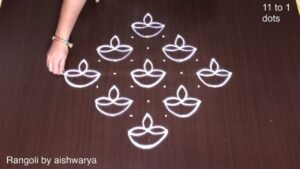
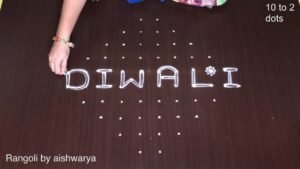
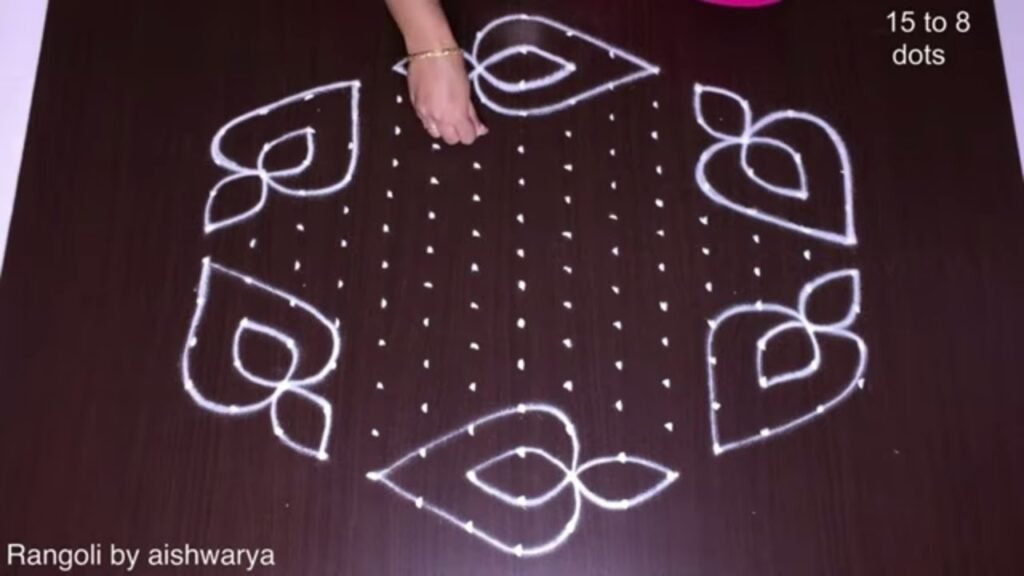
Diwali rangoli favours colour and lamp-light: freehand and radial compositions filled with powders, flower petals, and rows of diyas set into or around the design. Lamp motifs are drawn between real flames; lotus and Lakshmi’s-feet emblems mark the goddess’s expected path; date lettering and greeting text appear in the modern register. Designs sit at entrances, in courtyards, and before household shrines; scale runs from a quick doorstep piece to competition-grade floor paintings, and the festival’s evenings — when the lamps are lit above the coloured ground — are the drawing’s most photographed hour.
Cultural Context
The design is commonly made as welcome — for guests, and in wide practice for the goddess Lakshmi, whose visit the lit and decorated threshold is understood to invite; the inward-walking feet drawn at many doors state the invitation literally. The lamp rows that edge Diwali rangoli carry the festival’s central symbol into the drawing itself: light set against the year’s darkest new moon. These meanings are attributed, and broadly held across regions that otherwise share little vocabulary.
Regional Variations
Diwali’s drawing takes each region’s local form: coloured freehand rangoli through the north and west, kolam in Tamil households, muggulu in Telugu ones — the festival crosses traditions rather than belonging to any single one of them. In Gujarat the festival opens the mercantile new year, and the threshold’s auspicious mark extends to the shop door — the practice described in The Auspicious Mark; in Tamil practice the deeper lamp festival, Karthigai Deepam, follows weeks later.
Related Topics
The lamp motif is described in Diya; the goddess’s emblems in Lotus and Lakshmi’s Feet; centre-out festival composition in Radial Structure; the umbrella practice in Rangoli.
Gallery
References
- Vijaya Nagarajan, Feeding a Thousand Souls: Women, Ritual, and Ecology in India — An Exploration of the Kōlam, Oxford University Press, 2018.
Further Reading
- Jyotsna Kilambi, “Toward an Understanding of the Muggu: Threshold Drawings in Hyderabad”, RES: Anthropology and Aesthetics 10, 1985.
This entry publishes at Evidence Level E1: common knowledge within the tradition, anchored to a verified standard reference.
Cite this entry: “Diwali.” Rangoli Encyclopedia, Rangoli Designs, https://rangolidesigns.net/encyclopedia/diwali/ — a permanent URL under the encyclopedia’s stable-identity policy. Entry last reviewed 2026-07-28.