


Definition
The peacock is rangoli’s favourite bird: the Indian peafowl (Pavo cristatus) rendered as a figure of curved neck, crested head, and ornamental train, drawn anywhere from a few strokes to a full festival centrepiece. Among figurative motifs only the lotus appears more often.
The male bird supplies the imagery — iridescent blue body, green-bronze train, and the eye-marked display feathers that fan into a natural half-mandala. A mature train carries over a hundred display feathers, each with its concentric eye; the bird is, in effect, a walking exhibition of the radial ornament rangoli prizes.
History
Peacock imagery runs continuously through Indian art — temple sculpture, palace architecture, bronze lamps, miniature painting, textiles, jewellery — and through its literatures: classical Sanskrit poetry returns constantly to dancing peacocks before the rains, and the regional literatures took up the bird with equal affection. Classical dance traditions render its gait and display in choreographed movement. The threshold arts inherited a form the whole culture had already spent centuries refining.
The bird’s standing has a civic marker too: the Indian peafowl was declared India’s national bird in 1963. Its familiarity is real as well as artistic — peafowl live around villages, fields, and temple grounds across the subcontinent, so the artists who stylised it drew a neighbour, not an exotic.
The literary record deserves its own note, because it shaped how the bird is drawn. In classical poetry the peacock is rarely static: it dances, calls across forests, shimmers in sunlight, moves through gardens. The poets’ peacock is a bird of motion and longing, and the visual traditions absorbed that — rangoli peacocks lean, turn, and spread rather than merely stand, and classical dance carries the same observation into choreography: spreading feathers, flowing neck movement, rhythmic turning. One observed bird feeds three arts.
Description
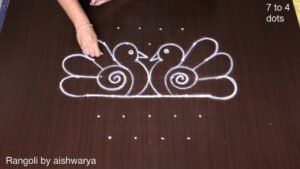
The repertoire runs from complete birds with expanded trains to radically simplified curve-figures. Standard forms include the full peacock, the stylised single-line bird beloved of kolam practice, the symmetrical facing pair flanking a central lotus or lamp, the peacock-with-lotus pairing, and feather borders — the eye-feather repeated as a running ornament around a composition.
What makes the bird so drawable is its geometry. The train is a natural system of repeating circles in radial arrangement; the neck and body resolve into two or three confident curves; the crest is a flourish. The form therefore survives extreme simplification — a peacock remains a peacock at five strokes — and rewards extreme elaboration, the festival register filling each feather-eye with colour. Design analysis notes the same qualities formally: concentric repetition, curved symmetry, rhythmic spacing.
Cultural Context
The peacock’s meanings grew from watched behaviour. Its spectacular displays coincide with the breeding season and therefore with the coming of the monsoon — ornithology reads the dance as courtship; agricultural communities read it as the announcement of rain. For societies whose year turned on the rains, the bird became a figure of hope: renewal, fertility, abundance, joy. Those senses — attributed, as this encyclopedia’s rule requires — remain the motif’s core, joined by elegance and celebration.
The monsoon association deserves emphasis because it explains the motif’s emotional register. For an agricultural society, no event mattered more than the rains: harvests, food security, and the year’s whole prospect turned on their arrival. A bird that visibly celebrated at exactly that moment became the natural emblem of anticipation rewarded — and a peacock drawn at the threshold carries that inheritance of hope whether or not a single cloud is in the sky.
Hindu iconography deepens the associations: the peacock is the mount of Kartikeya (Murugan), and the peacock feather belongs to Krishna’s crown; in some artistic traditions the bird accompanies Saraswati. A peacock in a festival rangoli can therefore carry devotional resonance alongside its seasonal joy — which meaning leads depends, as always, on the occasion.
Contemporary design keeps the bird in constant work — fashion, textiles, jewellery, architecture, graphic and digital art — and the rangoli peacock moves with the times, reinterpreted in minimal line or maximal colour without losing its identity. Few motifs demonstrate so clearly that a traditional vocabulary can stay contemporary simply by being kept in use.
Regional Variations
Maharashtra’s festival rangoli emphasises the coloured display at full spread; Tamil kolam simplifies the bird into elegant continuous-line forms; Karnataka’s rangavalli pairs it with floral ornament; Gujarat sets stylised peacocks among geometric and auspicious motifs; Rajasthan’s mandana admits simplified bird forms to its ochre-and-white geometry. The identity survives every regional accent.
The festival calendar sets the bird’s appearances as much as geography does. Peacocks flourish in the large competitive designs of the Sankranti season, join the coloured abundance of Diwali courtyards, and serve year-round wherever a composition wants a figure of celebration; in the daily register the bird appears in its simplest line forms, kept quick enough for a morning’s drawing. Scale follows occasion — the same motif that takes five strokes on an ordinary day may take an hour at festival size, every feather-eye filled.
Related Topics
The facing-pair composition typically flanks a Lotus or Diya; single-line peacocks belong to the drawing culture of Kolam; the bird’s great season is the festival calendar of Sankranti and Diwali.
Gallery
References
- Vijaya Nagarajan, Feeding a Thousand Souls: Women, Ritual, and Ecology in India — An Exploration of the Kōlam, Oxford University Press, 2018.
Further Reading
- Jyotsna Kilambi, “Toward an Understanding of the Muggu: Threshold Drawings in Hyderabad”, RES: Anthropology and Aesthetics 10, 1985.
This entry publishes at Evidence Level E1: common knowledge within the tradition, anchored to a verified standard reference.
Cite this entry: “Peacock.” Rangoli Encyclopedia, Rangoli Designs, https://rangolidesigns.net/encyclopedia/peacock/ — a permanent URL under the encyclopedia’s stable-identity policy. Entry last reviewed 2026-07-28.