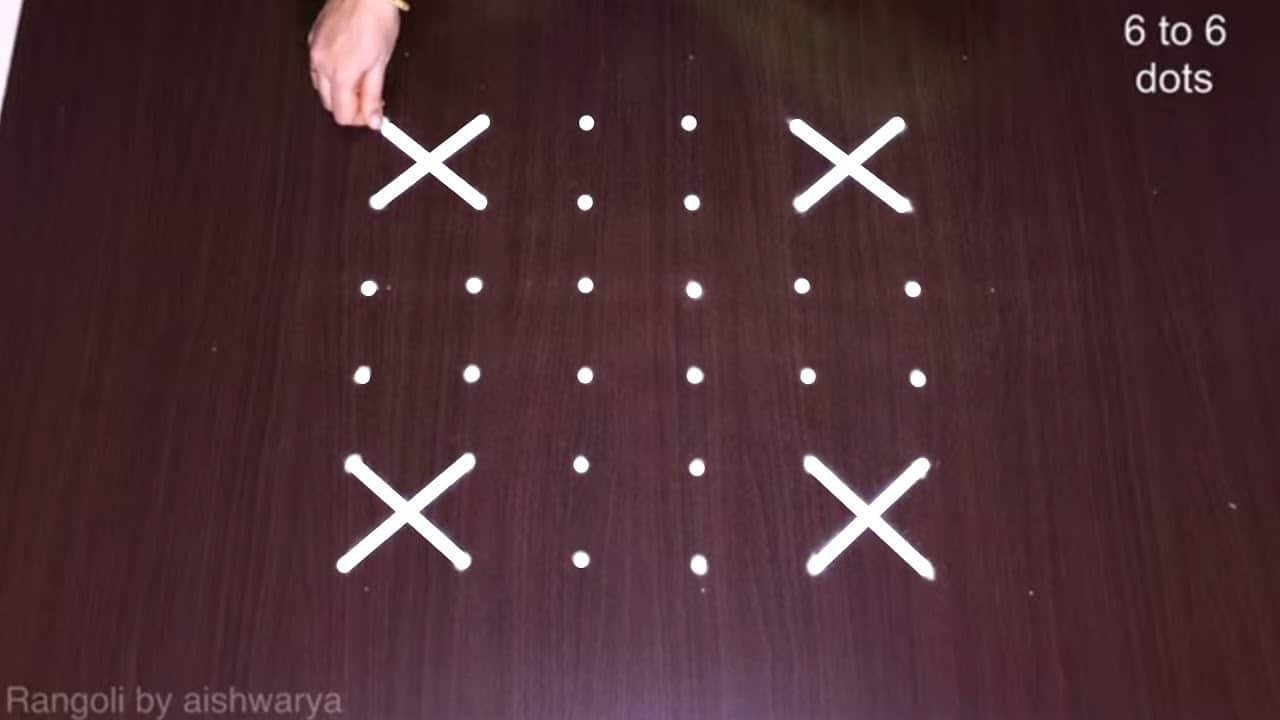
No hand moves with absolute precision, and the tradition has never pretended otherwise. Powder falls unexpectedly, a curve wanders, a line thickens mid-stroke — for beginners constantly, for masters still occasionally. What the practice teaches is not the avoidance of error but the craft of response: recognising a deviation early, correcting it without drama, and knowing which imperfections to fix and which to keep. That craft is as much a part of instruction as any stroke.
The beginner’s catalogue
The difficulties of the first seasons are so consistent across generations that they amount to a catalogue, each entry with its traditional remedy. Uneven line thickness comes from varying pressure and flow — and the remedy is counterintuitive: loosen the grip rather than tighten it, then practise long uninterrupted lines until consistency arrives on its own. Broken lines come from holding too little powder and from hesitation; the cure is continuity of movement, not the concealment of every gap. Uneven dot grids sabotage everything built on them — hence the rule that the frame deserves the care first, because correcting a misplaced dot is cheap and correcting a design built on one is not. Lopsided symmetry is answered by habit, not talent: compare opposite sides continuously while drawing, never only at the end. Excess powder is the beginner’s idea of strength and produces only blurred edges — controlled flow is the actual elegance. And rushing, the most universal fault, costs more time than it saves, since every hurried error must be paid for twice.
Recognising early
The dividing line between beginner and practitioner is when correction moves inside the drawing. Experienced artists evaluate line, spacing, and balance continuously as they work, so most adjustments happen within seconds of the deviation — the design is refined as it develops, not repaired after it is finished. This simultaneous seeing-and-drawing is a trained skill, and much of what looks like flawless execution is actually fast, quiet correction.
The gentle correction
The tradition’s signature move is to rebalance rather than erase. A curve that bent too far is answered by refining its neighbour; a variation on one side is echoed on the other until symmetry returns; an irregular edge is absorbed into a slightly bolder border. The correction preserves rhythm and leaves no scar — the finished design never confesses. This is the same principle that Learning the Line notes from the line-craft side, elevated here to a working philosophy: the composition is always adjustable as a whole, so no single stroke is ever fatal.
Working with the day
Many so-called mistakes are really conditions. Surfaces differ in texture and moisture; humidity changes how powder flows; wind scatters fine material; one batch of flour behaves unlike another. Practised artists read these conditions and adapt — slower strokes on rough ground, heavier release before weather — treating the surface as a partner rather than an opponent. Composure is part of the same craft: a disturbance is met by pausing, reassessing, and restoring rhythm, because a calm hand recovers and a startled one compounds.
When the flaw is the signature
Not every variation should be hunted down. Small irregularities are what distinguish a living hand from a printing process, and the tradition values that distinction: precision is the standard, perfectionism is not. A design drawn by a person on a particular morning carries the marks of both, and some of those marks are character. Knowing the difference — which deviations disturb the balance and which merely prove the work handmade — is a judgement that arrives late in the apprenticeship and marks its maturity.
The learner’s attitude
The catalogue’s final entry is not technical. Learners who compare their first designs with practised work discourage themselves out of the apprenticeship — the traditional rhythm compares today’s line only with yesterday’s. Confidence is built by repetition of what already succeeds, expanded gradually; masters continue to see flaws in work others admire, which is not dissatisfaction but the engine of refinement. Every design is both artwork and lesson, and the tradition’s oldest teacher — the mistake — is also its most patient.
References
- Vijaya Nagarajan, Feeding a Thousand Souls: Women, Ritual, and Ecology in India — An Exploration of the Kōlam, Oxford University Press, 2018.
- Jyotsna Kilambi, “Toward an Understanding of the Muggu: Threshold Drawings in Hyderabad”, RES: Anthropology and Aesthetics 10, 1985.
Further Reading
- Marcia Ascher, “The Kolam Tradition”, American Scientist 90(1), 2002.
This entry publishes at Evidence Level E2: its claims rest on at least two independently verified sources.
Cite this entry: “Mistakes and Corrections.” Rangoli Encyclopedia, Rangoli Designs, https://rangolidesigns.net/encyclopedia/mistakes-and-corrections/ — a permanent URL under the encyclopedia’s stable-identity policy. Entry last reviewed 2026-07-29.