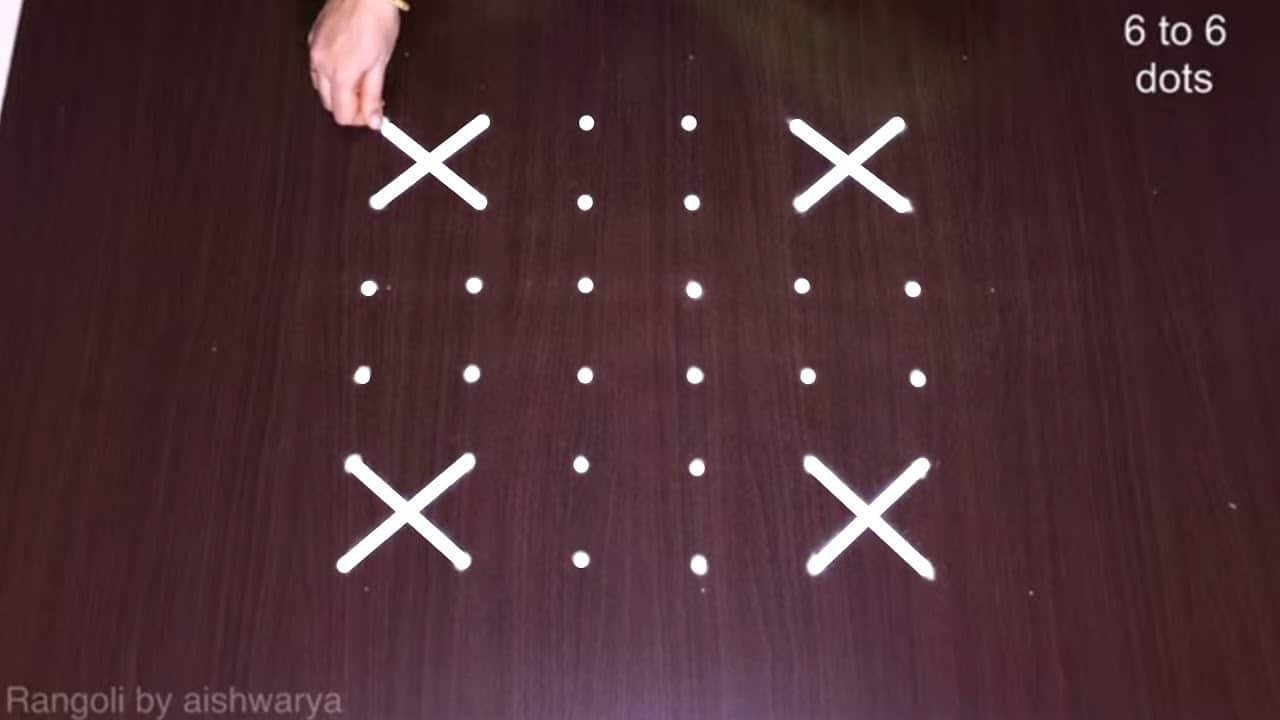
By the time a design begins, most of its quality has already been decided. The ground has been made ready or it hasn’t; the hand holds the powder well or it doesn’t. The tradition treats these preliminaries as the real foundation of the craft — which is why a chapter on technique starts before the first line exists.
Making the ground ready
Preparation begins with sweeping: dust, leaves, and grit are cleared not just for neatness but because powder lines need a clean bed to sit on. The surface is levelled where it can be — small irregularities read as wobbles in a straight line — and traditional earthen courtyards are lightly moistened, enough to settle the dust and hold the powder, never enough to clump it. The daily sweep-and-sprinkle is so integral that the ethnography treats it as part of the drawing itself: the same gesture that cleans the threshold begins the design. None of this is recent description: the 1937 scholarly record already states the same sequence as observed rule — the threshold swept and sprinkled with water, the pattern drawn on the clean, damp surface before sunrise — the earliest documented attestation of preliminaries the practice still keeps.
Every surface has a personality
Packed earth, the tradition’s original canvas, grips powder well and flatters white line with its warm ground. Cement and stone draw more smoothly but hold less in wind; polished tile is the modern challenge — unforgiving of excess, quick to show every flaw, demanding finer powder and a slower hand. Outdoor work adds weather to the calculation: wind argues for heavier material, coming rain for accepting a short life, festival traffic for durable minerals over delicate flour. Reading these conditions is a technical skill the practice teaches as thoroughly as any drawing movement.
The grip
The core technique of the whole art is a pinch. Powder rides between thumb and forefinger; the thumb meters the release; the grip stays relaxed — tension is the enemy, squeezing chokes the flow and shakes the line. From there the body divides the work by scale: fingers regulate release, the wrist shapes small curves, the forearm carries middle arcs, the shoulder swings the big ones. Posture underwrites it all — a stable, comfortable base, whether squatting, kneeling, or bent — and on large designs even walking joins the technique, steps planned so the artist moves around the growing pattern without reaching across or treading on the finished work.
Rhythm, then memory
Practised drawing settles into rhythm: breath, step, and release synchronise, and observers describe good practitioners as calm to the point of meditative — the calm is functional, since relaxed movement is even movement. With years, the whole apparatus disappears into what the tradition calls the hands knowing: conscious control becomes muscle memory, attention moves from mechanics to composition, and the practitioner’s individual rhythm becomes visible in the work itself — line quality as recognisable as handwriting. The preliminaries never stop mattering; mastery is when they no longer need thinking about. The tradition also reads the preliminaries a second way: preparing the ground is preparing the person. Sweeping and settling the threshold gathers the attention the drawing is about to need — an orderly surface and an orderly mind arriving together — and the ethnography records practitioners treating the whole sequence, broom to final loop, as one continuous act. Technique and readiness are not separate lessons; the first line goes right because everything before it did.
References
- Vijaya Nagarajan, Feeding a Thousand Souls: Women, Ritual, and Ecology in India — An Exploration of the Kōlam, Oxford University Press, 2018.
- Jyotsna Kilambi, “Toward an Understanding of the Muggu: Threshold Drawings in Hyderabad”, RES: Anthropology and Aesthetics 10, 1985.
- John Layard, “Labyrinth Ritual in South India: Threshold and Tattoo Designs”, Folklore 48(2), 1937.
Further Reading
- Marcia Ascher, “The Kolam Tradition”, American Scientist 90(1), 2002.
This entry publishes at Evidence Level E2: its claims rest on at least two independently verified sources.
Cite this entry: “Before the First Line.” Rangoli Encyclopedia, Rangoli Designs, https://rangolidesigns.net/encyclopedia/before-the-first-line/ — a permanent URL under the encyclopedia’s stable-identity policy. Entry last reviewed 2026-07-29.