Definition
Puthandu is the Tamil solar new year, falling in mid-April at the start of the month of Chithirai, and a morning of fresh beginnings at the threshold: a new kolam for the new year, drawn on ground washed before dawn.
History
The solar new year belongs to the same calendrical family as the mid-January harvest transition — the sun’s passage marked twice, at Thai’s turn and at Chithirai’s — and its household observances are kept within the Tamil ritual year the ethnography documents: the kanni, the arranged tray of auspicious things composed to be the year’s first sight; new clothes; the morning kolam. This article stays within that frame.
Description
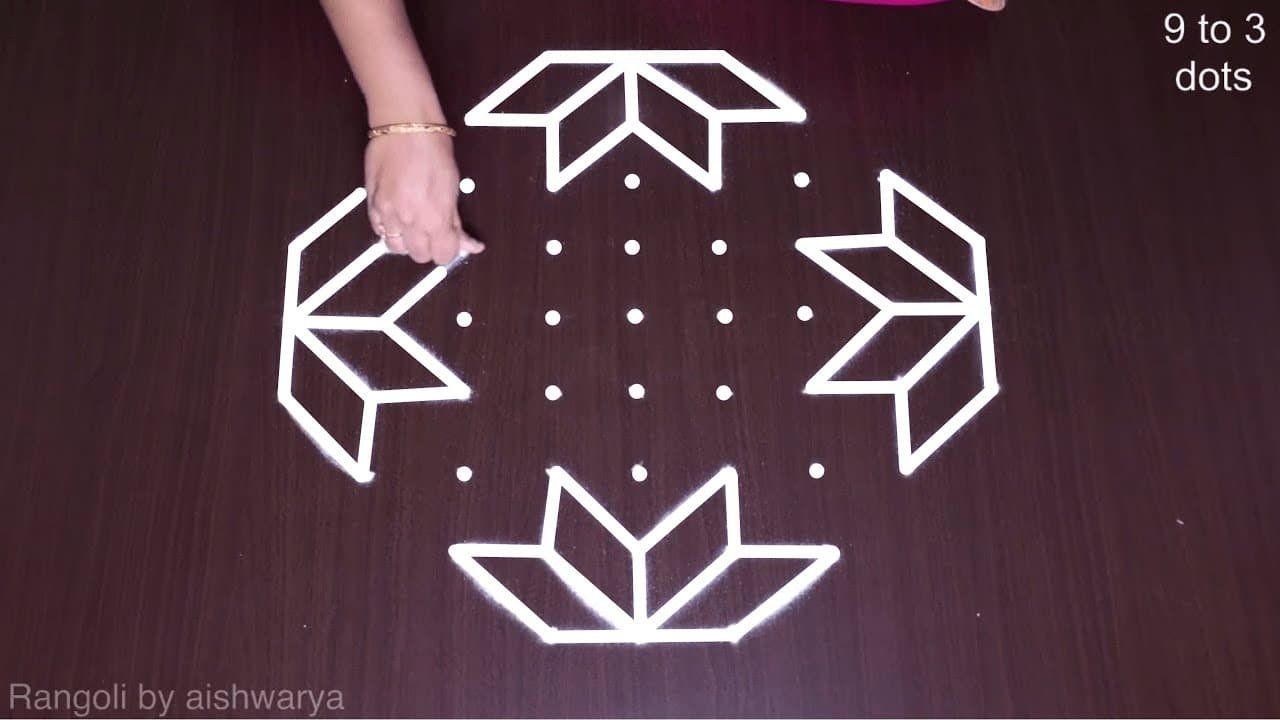
Puthandu kolams are bright single-morning designs: coloured rather than plain white, moderate in scale, and often paired with mango-leaf door hangings whose motif they echo in flour. The drawing is one element of a threshold prepared whole — washed, decorated, and stocked with the year’s first auspicious sights — and households that keep the kanni compose the design as part of the same curated morning: the door’s image and the tray’s arranged together the night before the eye falls on either.
Cultural Context
Beginning the year with an auspicious first view is the day’s organising idea, and the fresh kolam is commonly described as part of that curated first sight — the household’s opening image, made before the household is awake to see it. The reading is attributed, and widely held across Tamil new-year practice; it is also the threshold logic of the whole tradition compressed into one morning, which is why the day’s drawing is treated with festival care at everyday scale.
Regional Variations
The same mid-April solar new year is kept as Vishu in Kerala — with its own arranged first-sight tradition, the Vishukkani — and the lunar new year of the Deccan, Ugadi, precedes it by weeks. Each pairs the calendar with its region’s floor art; the family of new years, drawn in three traditions across six weeks of spring, is one of the clearest cases of one idea kept in several regional languages.
Related Topics
The tradition is Kolam; the mango motif drawn for the day is Mango; the neighbouring new years are Ugadi and New Year; the comparative frame is One Idea, Many Languages.
Gallery
References
- Vijaya Nagarajan, Feeding a Thousand Souls: Women, Ritual, and Ecology in India — An Exploration of the Kōlam, Oxford University Press, 2018.
Further Reading
- Jyotsna Kilambi, “Toward an Understanding of the Muggu: Threshold Drawings in Hyderabad”, RES: Anthropology and Aesthetics 10, 1985.
This entry publishes at Evidence Level E1: common knowledge within the tradition, anchored to a verified standard reference.
Cite this entry: “Puthandu.” Rangoli Encyclopedia, Rangoli Designs, https://rangolidesigns.net/encyclopedia/puthandu/ — a permanent URL under the encyclopedia’s stable-identity policy. Entry last reviewed 2026-07-28.