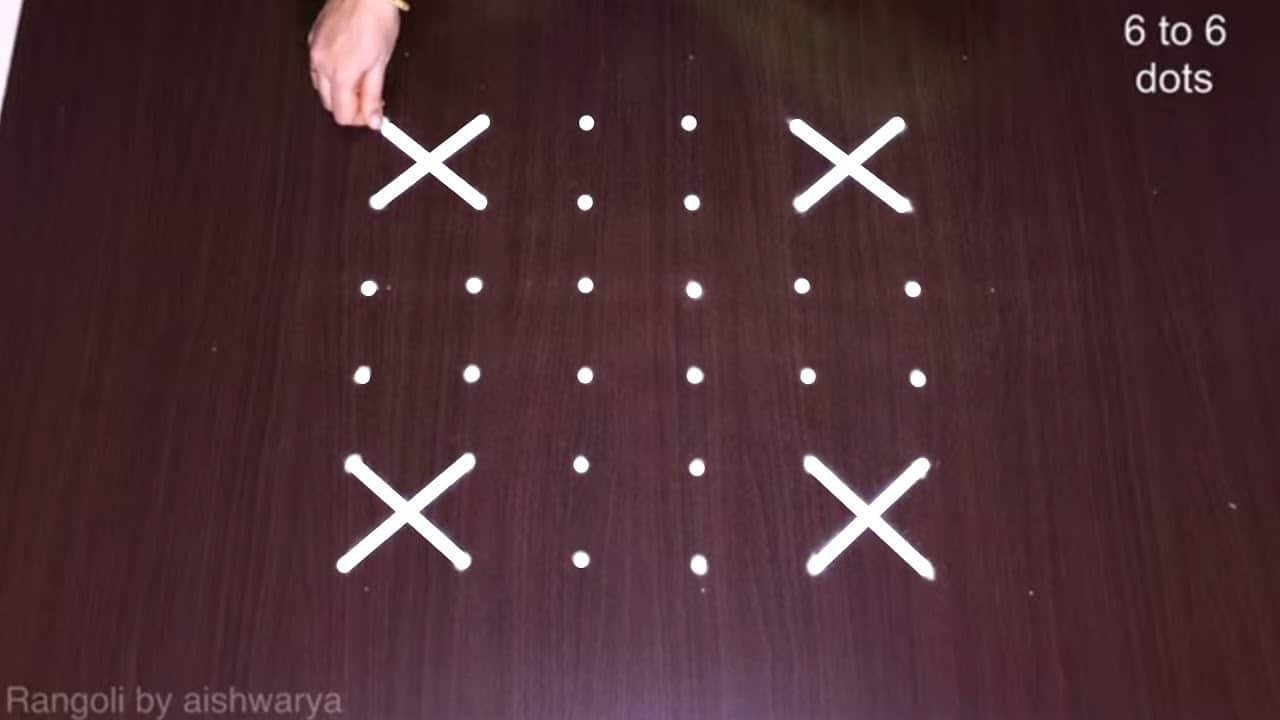
A dotted design is usually spoken before it is drawn. “Five by five.” “Fifteen to one.” “Twenty-one, eleven.” To anyone outside the practice these are just numbers; to a practitioner they are the design’s name — a complete geometric frame carried in two or three counts. Tutorials, archives, and the titles designs circulate under all identify work this way, and the habit is old: the count is the tradition’s notation system, its storage format, and its unit of teaching, all at once.
Reading the notation
The simplest form names uniform grids: 5×5 is five rows of five dots — twenty-five points, equal spacing, the balanced square that beginners start on and florals favour. The second form names the contracting frames: 7–1 means the longest row holds seven dots and successive rows shrink symmetrically to a single dot, producing the diamond outline that is the signature of so much pulli work; 15–1 is the same idea at ceremonial scale. Stepped sequences — 9–5–1, 21–11 — record coarser progressions for larger frames. Conventions vary by region and teaching lineage: some communities count aloud rather than write, some prefer one notation where a neighbour prefers another. What never varies is the principle — the numbers record the frame and nothing else.
Straight rows and offset rows
One more distinction completes the vocabulary. Rows may align dot-above-dot, or each row may sit offset into the gaps of its neighbour — ner pulli and idukku pulli in the Tamil terms, straight placement and interstitial placement. The choice splits the repertoire: straight rows carry the connect-and-frame families, while offset rows open the diagonals that flowing, interlaced work depends on. Two grids with identical counts but different placement support entirely different designs.
Beyond the four lattices
The core lattice families — square, triangular, hexagonal, staggered — are treated in Grids and Lattices; the working catalogue extends them. Rectangular frames run unequal rows and columns, fitted to the spaces thresholds and corridors actually offer. The diamond orientation is the square grid turned forty-five degrees — the same mathematics with a different energy, its rows reading as diagonals. Circular grids place dots on concentric rings around a centre, the natural frame for radial and mandala work. And the expanding-contracting diamond — one dot growing row by row to a widest span and shrinking back — is the most recognisable frame in the southern repertoire. Choosing among these is not preparation but design: the grid decides which symmetries the finished work can have before the first line exists.
The count is not the design
A count names a possibility space, not an artwork. The same 7×7 supports flowers, birds, stars, looping paths, and austere geometry; two practitioners handed the same count will finish with two different designs, each correct. This is why collections organise by count — the number is the stable identity underneath endlessly varying surfaces — and it is the everyday face of the combinatorial abundance described in Simple Rules, Infinite Patterns: the frame fixes positions, the practitioner chooses relationships.
Scaling the frame
The count also travels across sizes. The same 11–1 drawn on a doorstep or across a festival ground is the same design if every interval grows by the same ratio — the working form of what geometry calls similarity: shape preserved, size free. Practitioners scale by widening the spacing, not by adding dots, and adjust for the ground itself — coarser surfaces and longer viewing distances ask for wider intervals and bolder line. Small work rewards precision and close viewing; large work trades fine detail for presence and often for many hands. The geometry is indifferent to the change; only the experience shifts.
Numbers as memory
Seen whole, the count system is the answer to a transmission problem: how a tradition with no drawings on paper moves thousands of designs across generations intact. A design is remembered as its count plus a construction habit — where to start, how to turn — and both fit in memory and in speech. The practice assigned no coordinates and wrote no manuals, yet built a notation compact enough to say across a fence and precise enough to reproduce a frame exactly, and that notation now indexes the tradition’s designs on the web as it once did in courtyards. Counting, here, is what writing is elsewhere.
References
- Marcia Ascher, “The Kolam Tradition”, American Scientist 90(1), 2002.
- Gift Siromoney, Rani Siromoney & Kamala Krithivasan, “Array grammars and kolam”, Computer Graphics and Image Processing 3(1), 1974.
Further Reading
- Kiwamu Yanagisawa & Shojiro Nagata, “Fundamental Study on Design System of Kolam Pattern”, Forma 22, 2007.
This entry publishes at Evidence Level E2: its claims rest on at least two independently verified sources.
Cite this entry: “Counting the Grid.” Rangoli Encyclopedia, Rangoli Designs, https://rangolidesigns.net/encyclopedia/counting-the-grid/ — a permanent URL under the encyclopedia’s stable-identity policy. Entry last reviewed 2026-07-29.