Definition
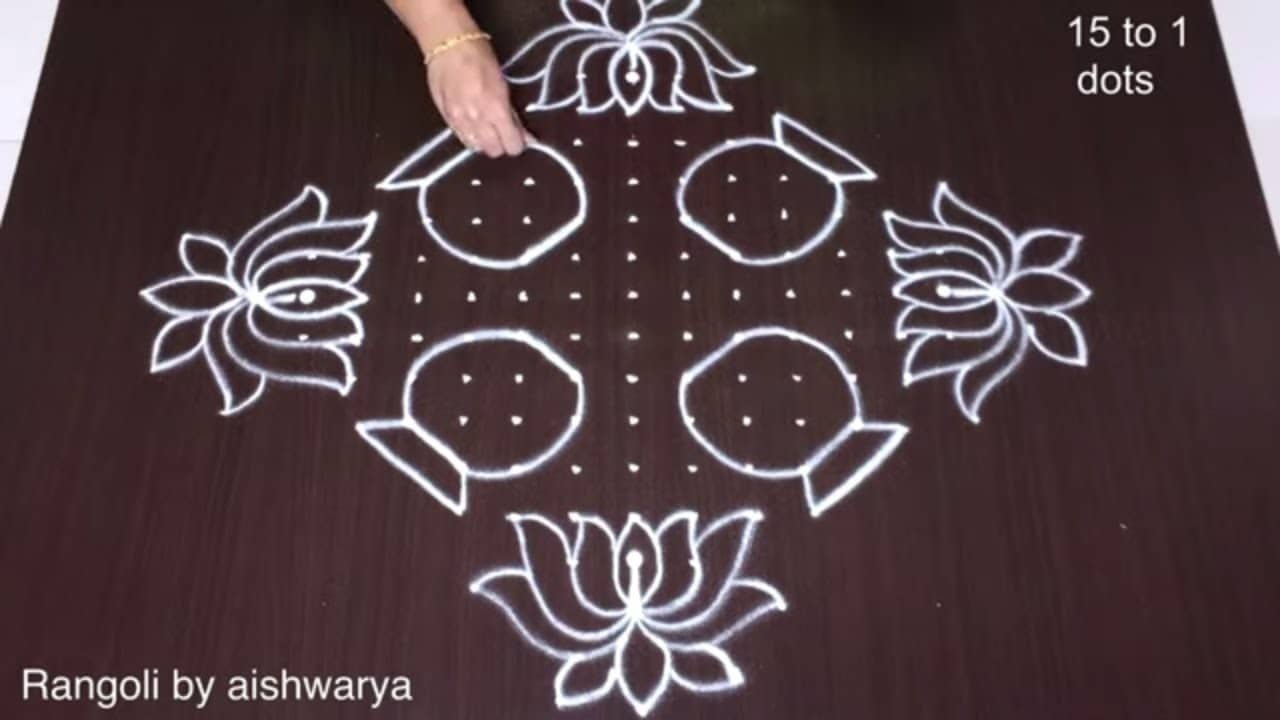
The fish motif — matsya — draws the aquatic form in stylised profile: almond body, curved tail, circular eye, fins and scales as decorative pattern. It appears singly, in mirrored pairs, and in circular schools around a central figure, and it is the rangoli vocabulary’s principal emblem of water and the abundance water makes possible.
Alone among the major animal motifs, the fish carries its element with it: to draw a fish is to imply water, and with water everything the culture associates with it — nourishment, fertility, movement, renewal. The motif’s meanings begin in that implication.
History
Fish imagery is ancient in the subcontinent — documented among Indus-era artefacts and continuing through temple sculpture, manuscript illustration, textiles, palace painting, folk art, and ceremonial vessels. The record tracks geography: river valleys and coasts, where fish meant food, trade, and the visible health of the waters, gave the motif its strongest artistic homes, and the eastern riverine cultures made it a first-rank symbol.
The symbolic logic grew from ordinary observation. Fish appear in abundance when waters are healthy and vanish when they fail; communities read them as living indicators of their environment’s condition — a reading modern ecology has formalised, with aquatic species still serving as standard indicators of ecosystem health. The prosperity the fish symbolises was always ecological before it was financial.
Description
The fish is an organic form that stylises with unusual grace. Artists reduce it to an almond and two curves, then elaborate: repeating scale patterns, fan tails, decorative fins. Its gently curved body creates directional movement — the eye follows a drawn fish as it would a swimming one — and the mirrored pair produces balanced rotational figures that suit rangoli’s symmetry perfectly. Standard forms include the single fish, the harmonious pair, circular fish arrangements around a lotus or geometric centre, and fish-with-lotus compositions joining water and purity.
The pair deserves its own note: two fish curved toward or around one another make one of the vocabulary’s most elegant closed figures, and in many communities the paired form specifically carries harmony, partnership, and shared prosperity — a favoured motif for weddings and household celebrations.
The scale pattern gives the motif a third life beyond outline and pair: the body as a field for repeating units — overlapping arcs, diamonds, dots — so that a large drawn fish becomes a sampler of pattern-work in miniature. Festival designs exploit this freely, filling the almond body with ornament the way border-work fills a frame; the fish is one of the few animal motifs that invites this treatment naturally, since its real referent is itself patterned.
Cultural Context
The fish’s attributed meanings cluster around abundance: fertility, good fortune, adaptability, the continuity of life — all extensions of the observed animal, numerous in healthy waters and effortless in movement. Hindu tradition deepens the story with Matsya, first of Vishnu’s ten avatars, who takes fish form to preserve life and sacred knowledge through a great flood: protection and preservation join the motif’s senses, the fish as the form rescue took. The meanings are brought to the figure, not found in it; the drawn figure is a stylised body and tail.
Bengal gives the motif its most intense cultural life — fish are woven into the region’s ideas of prosperity, celebration, and hospitality, and alpana practice draws them prominently — while coastal and riverine communities across Odisha, Kerala, Gujarat, and the northeast keep their own fish conventions. Contemporary practice has added an ecological voice: artists increasingly deploy the old abundance-symbol in campaigns for river and wetland conservation, the motif arguing for the waters that made it.
Regional Variations
Fish motifs concentrate where water shapes life: strongest in the eastern rice-paste traditions, prominent in coastal decorative arts, present across the southern grid traditions in stylised curve forms, and recurrent in festival rangoli everywhere water and prosperity are being honoured. The geography of the motif is a map of the civilisation’s relationship with its rivers and coasts.
Related Topics
The fish’s frequent companion is the Lotus, sharing its water; its serpentine neighbour in the water vocabulary is the Naga; the freehand curve-work it favours is described under Freehand; the umbrella practice is Rangoli.
Gallery
References
- Vijaya Nagarajan, Feeding a Thousand Souls: Women, Ritual, and Ecology in India — An Exploration of the Kōlam, Oxford University Press, 2018.
Further Reading
- Marcia Ascher, Mathematics Elsewhere: An Exploration of Ideas Across Cultures, Princeton University Press, 2002.
This entry publishes at Evidence Level E1: common knowledge within the tradition, anchored to a verified standard reference.
Cite this entry: “Fish.” Rangoli Encyclopedia, Rangoli Designs, https://rangolidesigns.net/encyclopedia/fish/ — a permanent URL under the encyclopedia’s stable-identity policy. Entry last reviewed 2026-07-28.