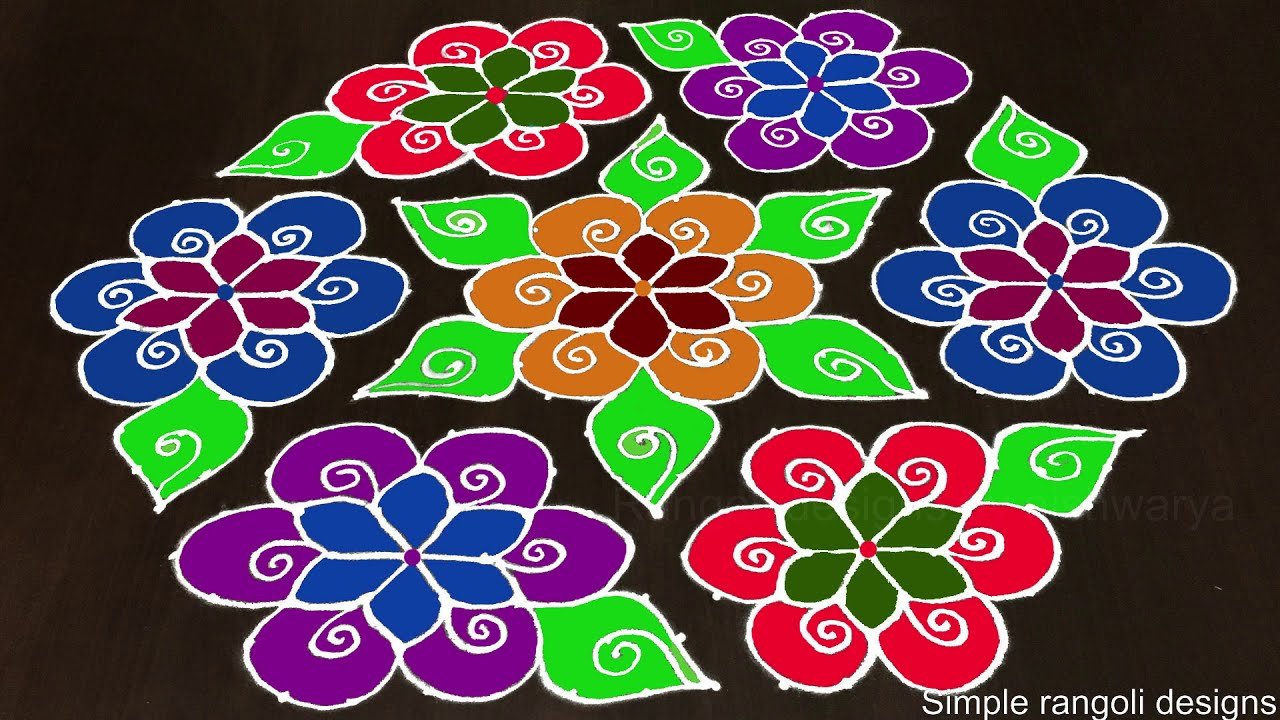
Set India’s named threshold arts side by side — kolam, muggulu, rangavalli, alpana, jhoti chita, aripan, mandana, aipan, sathiya, chowk poorana, kalamezhuthu — and two facts stand out at once. Each is unmistakably itself: a Tamil sikku kolam could never be confused with a Bengali alpana. And all of them are unmistakably one family. This essay is about the family resemblance — what the traditions share, and the honest ways they differ.
The shared core
Nearly every regional tradition is temporary, hand-drawn, bound to the threshold or the ceremony, transmitted inside households, and made from materials the local landscape provides. Beneath the linguistic diversity — dozens of regional names — sits one consistent cultural idea: ordinary space made meaningful through temporary art. The drawing welcomes, prepares, celebrates, and sanctifies; its meaning is in the making as much as in the made.
Materials follow geography
The clearest axis of difference is material, and it maps onto the land. The south draws dry: rice flour and white stone powder trailed between the fingers, which favours dots, counted grids, and disciplined line. The east paints wet: rice ground to a liquid paste and applied with the fingertips — the medium of alpana, jhoti chita, and aripan — which favours sweeping, brush-like curves. The west and north work in lime, chalk, and coloured earths, and the hill and desert traditions — aipan in Kumaon, mandana in Rajasthan — pair white pigment against a prepared red-ochre (geru) ground for maximum contrast. One tradition steps outside the powder-and-paste division altogether: Kerala’s pookalam is assembled from fresh flower petals rather than drawn in any medium, which is why its geometry runs to concentric rings of colour and its working unit is a petal rather than a line — the case is treated in The Flower Carpet. Technique follows material: a tradition’s characteristic line is, to a real degree, the behaviour of its medium.
Daily and ceremonial registers
A second axis is frequency. Some traditions are daily arts — the kolam, the muggu, the rangavalli — renewed every morning, building enormous fluency through repetition. Others are primarily ceremonial: Kerala’s kalamezhuthu exists inside temple ritual; the aipan tradition’s chowki compositions are made for specific rites; wedding aripan and festival chowk poorana are occasioned, not habitual. Many traditions hold both registers, with the daily form elaborating dramatically at festivals. Neither register is the superior one — the daily arts cultivate fluency, the ceremonial arts cultivate iconographic precision, and each preserves its knowledge accordingly.
Three kinds of geometry
Geometry is universal in these arts, but it does three different jobs. In the southern dot-grid traditions it is mathematical — counted lattices, symmetry, the continuous sikku line that research literature still studies. In the diagram traditions — aipan, aripan, chowk poorana — it is ritual: the composition organises a ceremonial space, and its arrangement belongs to the rite. In sathiya, mandana border-work, and the ornamental registers it is decorative: balance and rhythm in service of visual richness. The same circle can be a theorem, a consecration, or an ornament, depending on the tradition drawing it.
Custodians
Across nearly all of these traditions, the historical custodians have been women. Knowledge has moved from mother to daughter, neighbour to neighbour, through observation, imitation, and correction — a transmission system the Tamil ethnography documents in depth and the Hyderabad muggu study confirms for the Telugu practice. That system preserved sophisticated artistic and geometric knowledge for centuries without academies or manuals. Contemporary practice has grown more inclusive — competitions, classrooms, research, and digital documentation now involve artists of every description — without displacing the household line of transmission that made the traditions durable in the first place.
Impermanence, again
Every tradition in this family accepts erasure. Feet, wind, rain, and ritual completion take every design, usually within a day; Kerala’s kalamezhuthu goes further and erases its images deliberately when the ceremony ends. What persists is not the object but the capacity — the knowledge, the grammar, the trained hand. A museum preserves works; these traditions preserve the ability to make them, which is why they have outlasted every material they were ever drawn in.
Unity without uniformity
India’s floor arts show that cultural unity does not require artistic uniformity. One idea — the transformation of ordinary ground into meaningful ground — speaks a dozen regional languages, each shaped by its materials, its calendar, its rites, and its community. This encyclopedia treats each named tradition on its own terms, and several of the entries await regional scholarship that has not yet passed the source gate; this chapter holds what can be said now, comparatively and honestly, about the family as a whole.
References
- Vijaya Nagarajan, Feeding a Thousand Souls: Women, Ritual, and Ecology in India — An Exploration of the Kōlam, Oxford University Press, 2018.
- Jyotsna Kilambi, “Toward an Understanding of the Muggu: Threshold Drawings in Hyderabad”, RES: Anthropology and Aesthetics 10, 1985.
Further Reading
- Marcia Ascher, Mathematics Elsewhere: An Exploration of Ideas Across Cultures, Princeton University Press, 2002.
This entry publishes at Evidence Level E2: its claims rest on at least two independently verified sources.
Cite this entry: “One Idea, Many Languages.” Rangoli Encyclopedia, Rangoli Designs, https://rangolidesigns.net/encyclopedia/one-idea-many-languages/ — a permanent URL under the encyclopedia’s stable-identity policy. Entry last reviewed 2026-07-30.