The tradition’s curriculum has never been a catalogue of designs. It is a progression of movements: the straight line, the curve, the circle, the dot — practised until each is dependable, then combined. Every elaborate composition in this encyclopedia decomposes into those four elements, which is why teachers begin there and masters never stop returning.
The four exercises
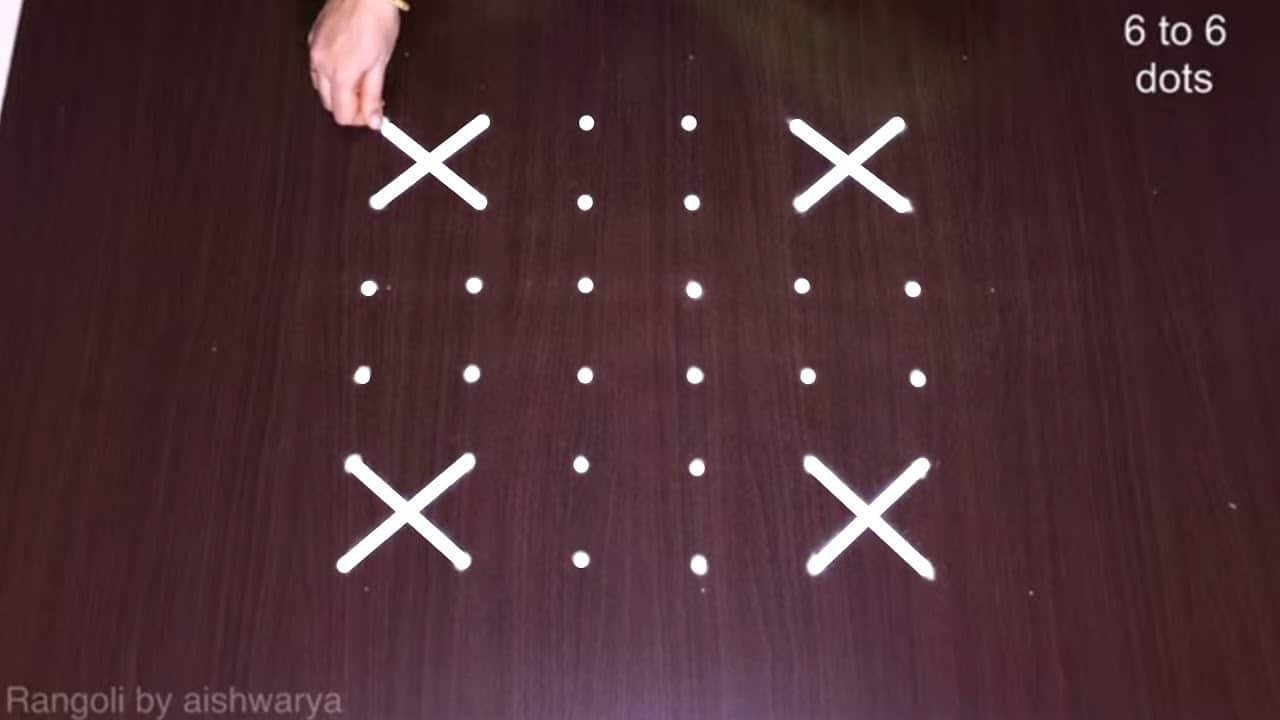
The straight line teaches steadiness — even flow, even speed, no hesitation; learners draw parallels until the lines stop wavering. The curve teaches continuous adjustment, direction changing smoothly without corners. The freehand circle is the discipline’s benchmark: closing a balanced round without instruments coordinates everything at once. And the dot grid teaches placement — equal spacing, true rows, counted arrangements — the quiet skill the entire southern practice stands on. None of these is beginner’s material to be outgrown; experienced practitioners drill them for the same reason musicians play scales.
Line quality: the visible skill
What separates practised work from beginner’s work is rarely the pattern — it is the line. Good lines hold uniform thickness (flow, pressure, and speed in balance), run continuous (breaks read instantly), and keep rhythm across repeats. The tradition treats this as settled craft knowledge: uneven lines are noticed before a viewer can say why a design feels off. Control also means pacing — slowing into tight detail, opening up along easy runs — and knowing how to absorb a small error: not by starting over but by adjusting neighbours until balance returns, a correction the finished design never confesses.
The eye does the measuring
Freehand accuracy is the craft’s summit: proportion judged by comparison rather than measurement, symmetry built by working outward from a centre and continually checking opposite sides, spacing held by an eye trained to notice millimetres. The practice trains this judgment deliberately — learning happens by watching as much as drawing, and repertoire lives in memory as whole patterns, recalled and adapted rather than copied. What looks like talent is documented process: observation, imitation, correction, repeated for years.
Trust, then freedom
The progression ends in confidence — the stage where hesitation leaves the line because the hand has earned trust. Confidence is not speed; it is calm, and it shows in the work: smooth transitions, committed curves, designs adapted freely to odd spaces and occasions because the practitioner is no longer executing a diagram but thinking in the medium. That is the freedom the whole apprenticeship purchases, and it explains the tradition’s patience with beginners: every master’s first lines wobbled too, and the path from one to the other is the same four exercises, kept honestly. Between grid and freedom sits the tradition’s pivotal exercise: joining the dots. The learner first connects points directly — the plain geometry of the beginner — then learns to travel around them, curving through the gaps, and in that single change of relationship the grid stops being a puzzle to complete and becomes a field to move through. Every interlaced masterpiece in this encyclopedia is that lesson, scaled up.
References
- Vijaya Nagarajan, Feeding a Thousand Souls: Women, Ritual, and Ecology in India — An Exploration of the Kōlam, Oxford University Press, 2018.
- Marcia Ascher, “The Kolam Tradition”, American Scientist 90(1), 2002.
Further Reading
- Kiwamu Yanagisawa & Shojiro Nagata, “Fundamental Study on Design System of Kolam Pattern”, Forma 22, 2007.
This entry publishes at Evidence Level E2: its claims rest on at least two independently verified sources.
Cite this entry: “Learning the Line.” Rangoli Encyclopedia, Rangoli Designs, https://rangolidesigns.net/encyclopedia/learning-the-line/ — a permanent URL under the encyclopedia’s stable-identity policy. Entry last reviewed 2026-07-29.