
Definition
The banana motif draws the banana plant and its parts — the broad arching leaf above all, plus fruit clusters and the full plant with its layered pseudostem — as emblems of hospitality and everyday abundance. Its most characteristic use is architectural: paired banana plants drawn (as they are physically placed) flanking an entrance during weddings and festivals.
The plant behind the motif is botanically a giant herb, not a tree: the apparent trunk is a column of overlapping leaf bases, and the plant fruits once before new shoots rise from the same root — a detail the symbolism has always quietly used.
History
The banana (Musa) has fed and served the subcontinent for millennia: fruit, flower, and stem all eaten, leaves used as plates and wrappings, fibre worked into craft. Its ceremonial career follows southern practice especially — fresh banana plants set at either side of doorways for weddings, temple festivals, and celebrations, their green promising vitality and increase — and its artistic record runs through temple sculpture, murals, textiles, and festival decoration.
The banana-leaf meal is the tradition’s most familiar gesture: food served on a fresh leaf expresses welcome, cleanliness, and respect, and the leaf returns to the soil afterwards — hospitality and ecological sense in one custom, practised long before either had a vocabulary.
Description
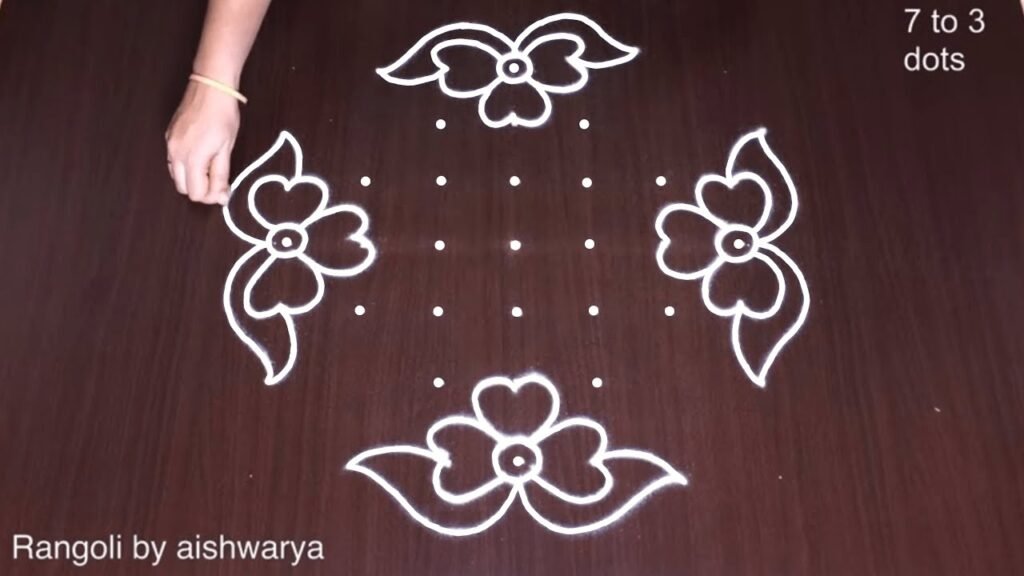
The leaf is the drawable heart of the motif: an elongated oval with a strong midrib and parallel veining, gently arched, instantly identifiable at any stylisation. Artists deploy it singly, in paired arches over an entrance-facing composition, and as running border units; fruit clusters are drawn as stacked crescents; the full plant — layered stem, crowning leaves, hanging cluster — appears in ceremonial compositions, most often as a symmetrical pair.
Design practice values the leaf’s sweep: its long curve introduces directional movement the way the mango leaf’s smaller form cannot, and a pair of arching banana leaves frames a centre with a natural gateway gesture — the drawn version of the doorway planting.
Cultural Context
The banana’s meanings are the household virtues of increase: fertility, prosperity, hospitality, celebration, continuity. The plant earned them observably — fast growth, generous fruit, usefulness in every part, and perpetual renewal from the rhizome, one generation rising as the last completes. Communities read that cycle as family itself. The senses are theirs, brought to a drawn leaf and stem; the plant simply behaves in ways that reward the reading.
What distinguishes the banana among the abundance emblems is its ordinariness: not a rare treasure but prosperity at household scale, available to any courtyard. The motif’s message is abundance shared — the feast served on a leaf, the doorway greened for a wedding — which is why it belongs so naturally to thresholds.
The leaf deserves its own footnote in the ecology of custom: naturally water-repellent, hygienic, abundant, and compostable, it served as tableware for centuries before disposable packaging existed and outperforms most of what replaced it. The banana-leaf meal is hospitality and environmental sense fused into a single gesture — and the drawn leaf carries a trace of that double virtue wherever it borders a design.
Regional Variations
The ceremonial banana is strongest in the south, where doorway plants and leaf meals remain living practice and the motif follows festival rangoli everywhere; the eastern and western traditions draw the leaf and fruit within their own festival vocabularies. Urban practice keeps the symbol where the planting has lapsed — the drawn pair of plants standing in for the real ones.
Related Topics
The banana’s fellow leaf emblem is the Mango; its ceremonial companions are the Kalash and Coconut; its great occasions include Pongal and Onam, the harvest feasts its leaves still serve.
Gallery
References
- Vijaya Nagarajan, Feeding a Thousand Souls: Women, Ritual, and Ecology in India — An Exploration of the Kōlam, Oxford University Press, 2018.
Further Reading
- Marcia Ascher, Mathematics Elsewhere: An Exploration of Ideas Across Cultures, Princeton University Press, 2002.
This entry publishes at Evidence Level E1: common knowledge within the tradition, anchored to a verified standard reference.
Cite this entry: “Banana.” Rangoli Encyclopedia, Rangoli Designs, https://rangolidesigns.net/encyclopedia/banana/ — a permanent URL under the encyclopedia’s stable-identity policy. Entry last reviewed 2026-07-28.