

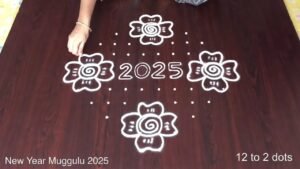
Definition
New Year — the calendar’s January first — is the youngest occasion in the rangoli year and one of its most drawn: a modern, pan-Indian moment when thresholds receive celebratory designs, greetings written in flour, and date numerals worked into the pattern itself.
History
Unlike the festival occasions of the ritual calendar, January’s drawing is a contemporary practice with no treatment in the scholarly literature this encyclopedia draws on; its evidence here is the design library itself, whose New Year corpus documents the practice directly and at scale. The habit is easy to place: the Gregorian date arrived with the modern calendar, and the threshold treated it as it treats any beginning — with a drawing. That the practice needed no doctrine to adopt the date is itself the observation worth recording.
Description
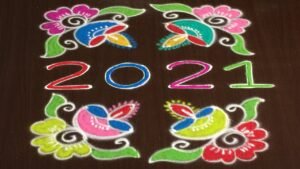
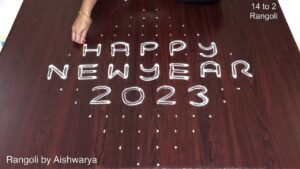
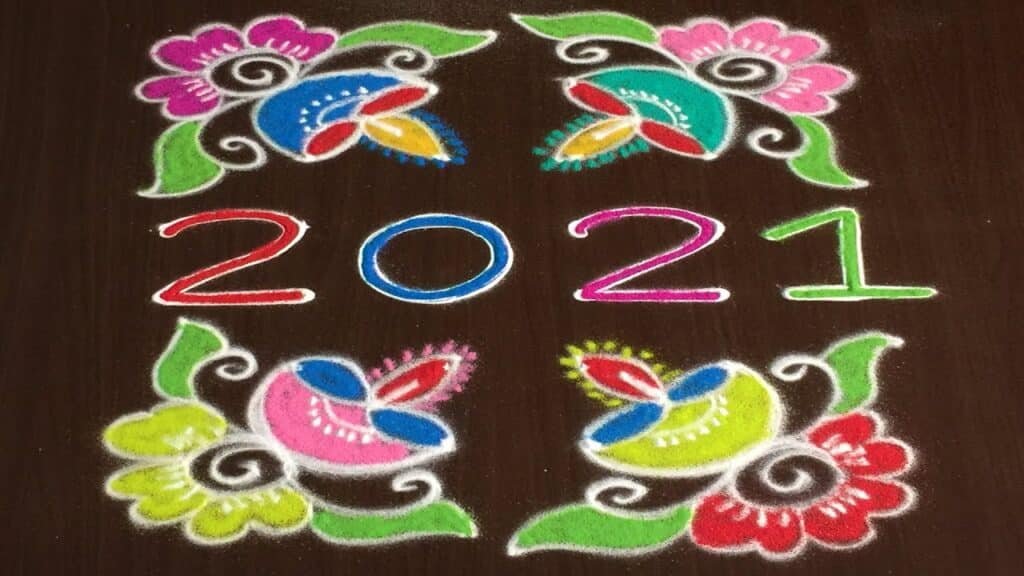
New Year designs borrow freely across the repertoire: dotted and freehand forms, “Happy New Year” lettering, and the year’s numerals drawn large and coloured — the tradition’s only occasion on which text is a standard element. They are festive single-morning pieces, drawn for midnight or the first dawn, and they sit comfortably beside the traditional calendar: the same threshold carries Margazhi kolams the same month, the January date landing mid-season in the southern drawing year.
Cultural Context
The practice extends the threshold’s oldest logic to a new calendar: begin the year with the door made auspicious. Practitioners treat the January drawing as celebration rather than observance — a distinction the tradition itself draws, and one this encyclopedia records as attributed. The lettered greeting makes the design’s audience explicit in a way the older repertoire never needed to: the drawing has always greeted; this one says so.
Regional Variations
January designs appear wherever rangoli is drawn, in each region’s own style; the traditional new years — Ugadi and Puthandu — follow in spring with their own conventions, and the library’s corpus shows all three coexisting on the same thresholds across the year.
Related Topics
The season it lands inside is Margazhi; the traditional new years are Ugadi and Puthandu; lettered and numeral designs are freehand work — see Freehand.
Gallery
References
- Vijaya Nagarajan, Feeding a Thousand Souls: Women, Ritual, and Ecology in India — An Exploration of the Kōlam, Oxford University Press, 2018 — for the threshold logic the modern practice extends.
Further Reading
- Jyotsna Kilambi, “Toward an Understanding of the Muggu: Threshold Drawings in Hyderabad”, RES: Anthropology and Aesthetics 10, 1985.
This entry publishes at Evidence Level E1: common knowledge within the tradition, anchored to a verified standard reference.
Cite this entry: “New Year.” Rangoli Encyclopedia, Rangoli Designs, https://rangolidesigns.net/encyclopedia/new-year/ — a permanent URL under the encyclopedia’s stable-identity policy. Entry last reviewed 2026-07-28.