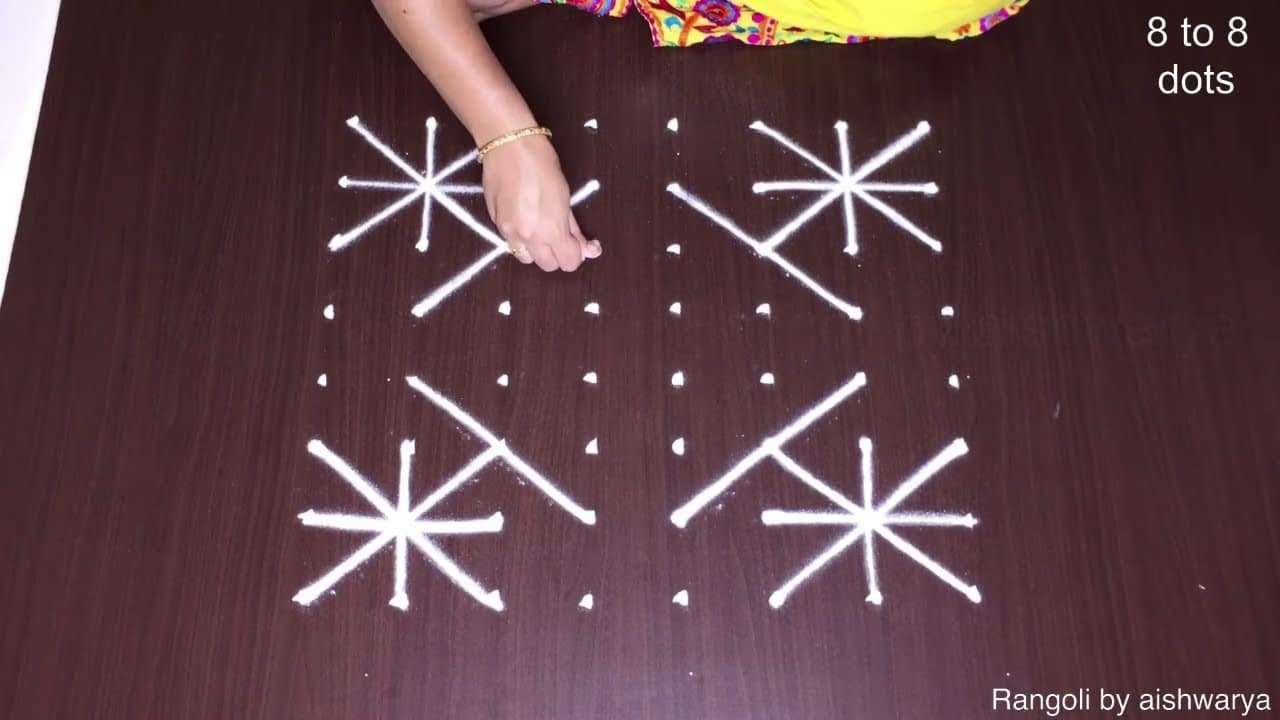
In Gujarat the practice and its central motif share one name. Sathiya is the Gujarati word associated with the ancient swastika — and it names both that auspicious sign and the threshold designs built around it. The symbol’s Indian history runs back thousands of years through Hindu, Jain, and Buddhist use, carrying meanings of well-being and auspicious beginning that are entirely independent of, and far older than, the symbol’s twentieth-century political misuse in Europe; the Swastika article covers that history in full. This essay is about the practice: what western India built around its mark of good beginnings.
The threshold and the shop door
Gujarat’s floor art grew up in a mercantile culture. For centuries the region connected India to Asia, Africa, and the Middle East by sea, and in that world of trade the decorated entrance became a statement homes and businesses made alike. The tradition’s most distinctive habit follows: at Diwali — which for many Gujarati families closes one accounting year and opens the next — homes, temples, and business premises are decorated with sathiya designs, and the new year’s books are opened under the mark. Hospitality and prosperity are drawn in one gesture; the art belongs to the shop door as naturally as the household threshold.
Geometry in the family of crafts
The visual language favours clear ornamental balance over the continuous-line mathematics of the south: squares, circles, diamonds, triangles, intersecting lines, concentric borders, symmetrical grids. What makes the geometry distinctly Gujarati is its kinship — the same patterns run through the region’s embroidery, weaving, wood carving, jewellery, and architectural decoration. The floor designs are one member of an interconnected craft landscape, which is much of why they read as instantly regional.
The wider vocabulary
Around the central mark gathers a familiar auspicious cast: the lotus, the kalasha vessel, Lakshmi’s footprints welcoming prosperity into the household, mango leaves for vitality and celebration, the peacock, the conch, and floral borders framing the whole. Artists combine several motifs in one composition, tuned to festival and family custom. The materials are the western staples: white limestone powder, chalk, and rice flour for the line; turmeric and vermilion for ceremonial colour; coloured powders and flower petals when festivals ask for more. Many practitioners keep to the natural set — the palette their region has always drawn from. A decorated Gujarati entrance does several jobs at once — beautifying the architecture, marking identity, preparing ceremonial space, announcing welcome — and this tradition adds one more: declaring the enterprise behind the door open to fortune.
Two communities, one practice
Gujarat’s religious landscape shaped the art from both sides. Hindu and Jain communities have each long employed decorative floor designs for worship, festivals, pilgrimage, and family ceremony, and though motifs shift with context, both traditions prize the same things — cleanliness, auspicious decoration, the careful preparation of ceremonial space. The shared values, more than any shared pattern, are what enriched the practice across centuries.
A mark that makes beginnings
The calendar of the practice reads as a list of starts: Diwali and Bestu Varas, the Gujarati new year; Navratri; weddings; housewarmings; temple celebrations. That is the tradition’s coherence — the sathiya is drawn wherever something begins, opening doors, years, ledgers, and marriages with the same mark. In modern Ahmedabad as in the villages, the practice continues wherever beginnings do, and among Gujarati communities worldwide it travels as the most portable of the floor arts: one auspicious sign, drawn first.
References
- Vijaya Nagarajan, Feeding a Thousand Souls: Women, Ritual, and Ecology in India — An Exploration of the Kōlam, Oxford University Press, 2018.
- Jyotsna Kilambi, “Toward an Understanding of the Muggu: Threshold Drawings in Hyderabad”, RES: Anthropology and Aesthetics 10, 1985.
Further Reading
- Marcia Ascher, “The Kolam Tradition”, American Scientist 90(1), 2002.
This entry publishes at Evidence Level E2: its claims rest on at least two independently verified sources.
Cite this entry: “The Auspicious Mark.” Rangoli Encyclopedia, Rangoli Designs, https://rangolidesigns.net/encyclopedia/auspicious-mark/ — a permanent URL under the encyclopedia’s stable-identity policy. Entry last reviewed 2026-07-29.