Definition
The parrot motif — shuka — draws India’s familiar green parakeet in profile: oval body, round head, curved red beak, and the long tapering tail that gives the figure its sweep. It appears singly, in affectionate pairs, perched on branches, and among flowers and fruit, bringing colour and conversational liveliness to compositions that the grander birds would formalise.
The bird behind the motif is the rose-ringed parakeet (Psittacula krameri), a species that thrives beside people — in orchards, villages, temple gardens, and cities — which is why the artists who stylised it were drawing a daily companion rather than a distant wonder.
History
The parrot’s artistic record runs through temple sculpture, palace murals, miniature painting, textiles, carved wood, and jewellery, and its literary record is richer still. Classical and medieval literature made the parrot a speaker: clever companion, messenger, observer of human affairs — most famously in the Shukasaptati, the “Seventy Tales of the Parrot”, where a wise parrot narrates story after story to instruct and delay, intelligence itself given feathers. The bird’s real capacity for vocal imitation earned it the role, and the role fixed its symbolism.
Painting traditions kept the bird in constant employment — Rajasthani and Deccani miniatures, Madhubani, Pattachitra, Kalamkari — usually among flowering trees or beside garden figures, its green a reliable accent against every ground. Rangoli inherited a bird the other arts had already made articulate.
Description
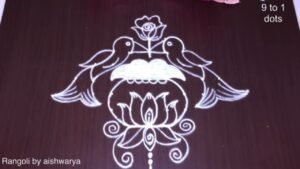
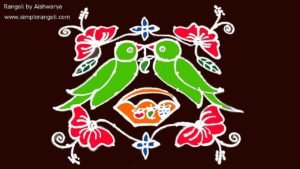
The parrot reduces to simple geometry without losing itself: oval body, circle head, hook of beak, and the tail’s long curve — the feature design analysis singles out, since a long-tailed bird creates directional movement, guiding the eye across a composition the way the fish’s body does. Standard forms include the single parrot, the facing or perched pair, parrot-with-flowers and parrot-on-branch arrangements, and fully stylised decorative parrots where curve and colour matter more than species.
Colour is the motif’s second signature. In coloured rangoli the parrot’s green — with red beak accent — is one of the vocabulary’s most vivid notes, and artists place it deliberately against warm grounds; in white-line kolam practice the same bird survives as pure silhouette, tail sweeping through the grid.
Cultural Context
The parrot’s attributed meanings are the sociable virtues: communication, learning, affection, friendship, joyful vitality. They grew from watched behaviour — flocking, constant calling, quick learning, long memory — and modern ornithology has ratified the folk assessment, ranking parrots among the most intelligent of birds, capable of vocal learning and problem-solving. Where the peacock means glory and the elephant means dignity, the parrot means good company.
In Hindu artistic tradition the parrot accompanies Kamadeva, the deity of love — the bird of springtime, youthful affection, and gardens in flower — and the pair-of-parrots form carries companionship and mutual understanding into wedding and festival designs. A gentler ecological sense attaches too: parrots live where trees flower and fruit, so their presence implies flourishing gardens — an implication conservation biology now states formally, with birds as indicators of habitat health. Attributed meanings, as this encyclopedia’s rule marks them, and unusually affectionate ones.
The storytelling association rewards a closing thought. In the centuries when stories carried a culture’s ethics and memory, the tradition chose the parrot as its narrator — the bird that could speak made the bird that could teach. A parrot in a rangoli therefore carries, faintly but really, the sense of words worth hearing: conversation, instruction, the pleasures of an articulate household. No other motif in the vocabulary symbolises speech.
Regional Variations
Parrot motifs appear across the regional traditions — in the coloured festival styles of the north and west, the line-drawn birds of southern kolam and muggulu practice, and the painted birds of the eastern arts — with the strongest presence wherever floral composition dominates, since the parrot is above all a bird of gardens. Contemporary use runs from murals and textiles to children’s illustration, the bird’s cheerfulness intact across every medium.
Related Topics
The parrot’s grander counterpart is the Peacock; its garden companions are the Creeper and Mango; its swan-like relative in the bird vocabulary is the Hamsa; the umbrella practice is Rangoli.
Gallery
References
- Vijaya Nagarajan, Feeding a Thousand Souls: Women, Ritual, and Ecology in India — An Exploration of the Kōlam, Oxford University Press, 2018.
Further Reading
- Jyotsna Kilambi, “Toward an Understanding of the Muggu: Threshold Drawings in Hyderabad”, RES: Anthropology and Aesthetics 10, 1985.
This entry publishes at Evidence Level E1: common knowledge within the tradition, anchored to a verified standard reference.
Cite this entry: “Parrot.” Rangoli Encyclopedia, Rangoli Designs, https://rangolidesigns.net/encyclopedia/parrot/ — a permanent URL under the encyclopedia’s stable-identity policy. Entry last reviewed 2026-07-28.