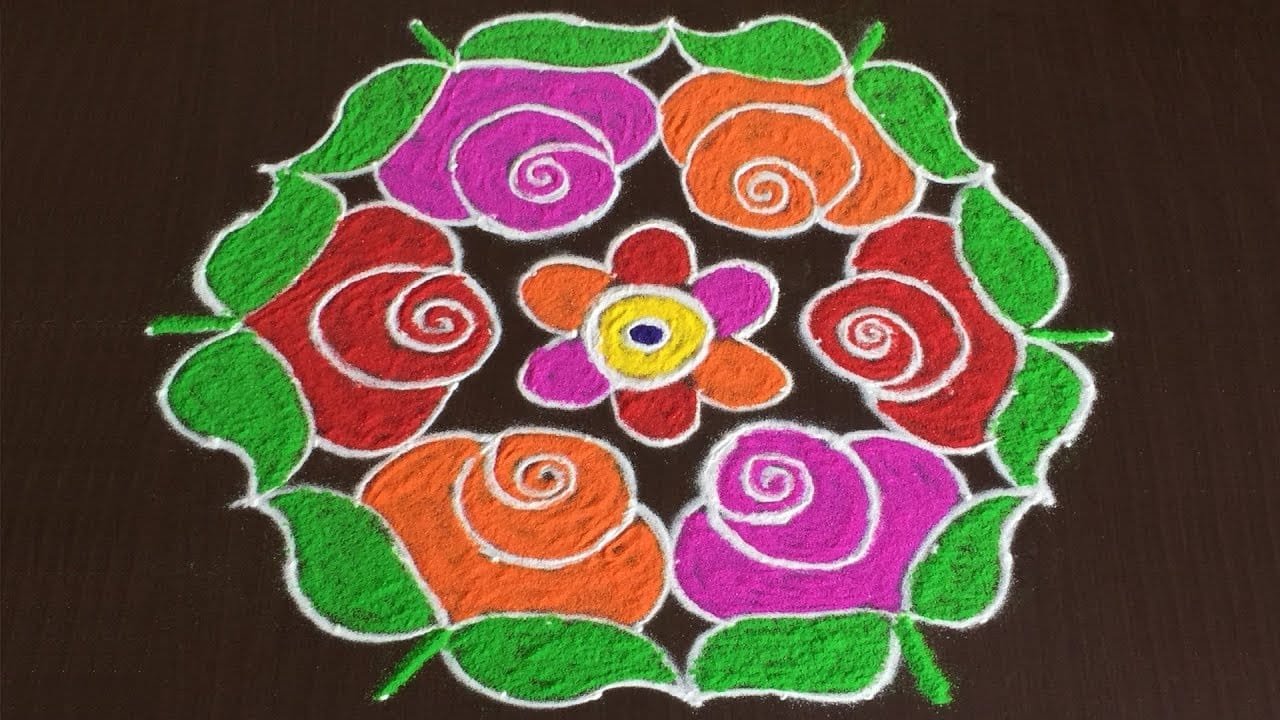
The plainest social fact about the documented threshold traditions is one this encyclopedia’s sources state on their title pages: the practitioners are women. Nagarajan’s Tamil fieldwork is by its own subtitle a study of women, ritual, and ecology; Kilambi’s Hyderabad account documents the muggu as the work of the household’s women. Taken together with the scale of the practice — designs renewed daily across millions of thresholds — they describe one of the largest bodies of public geometric art in the world, sustained almost entirely by women whose names the record does not keep.
An office of the household
Within the households the ethnographies describe, the threshold’s care is not a hobby that happens to be gendered; it is an office — a responsibility for the boundary between house and world that belongs to the women of the family, carried out before the household’s day begins. What passes from mother to daughter is therefore more than technique. The movements themselves are the subject of How the Hand Learns; what transfers with them is the office — the duty of the morning line, and the standing that comes with keeping it well.
Skill as standing
Because every threshold faces the street, every morning’s work is read. Neighbours pass the same doorways daily and know whose hand is steady, whose grids are true, whose repertoire runs deepest in festival season; the great occasions formalise the reading into open competition. This is reputation without signature — The Unnamed Masters examines why the tradition never attached names to designs — and its currency circulates chiefly among women. Standing earned at the threshold is standing within the community of practitioners: recognition attaches to the hand and the household rather than to a signed work.
A daily public voice
The arrangement contains a quiet inversion. The practitioners the ethnographies describe spent much of their recorded lives in domestic work, yet the art they keep is the most public thing a house produces — placed at the one point everyone must pass, renewed daily, addressed to the entire street. Nagarajan reads the kolam in exactly these terms: a form of women’s public expression, authorship exercised every morning in the most visible position a household owns. The gallery is the street, and the artists whose work fills it were never anonymous to their neighbours — only to the record.
Repertoires travel with women’s lives
A practice carried by women inherits the geography of women’s lives. The transmission the ethnographies document runs through households — watching, imitation, correction, inheritance — so repertoires move as practitioners do, and styles meet where lives join households across villages and regions. The regional map drawn in this encyclopedia’s tradition entries is, at street level, the accumulated pattern of those journeys.
The office under change
Urban employment, apartment thresholds, and new working mornings have changed what the office asks — often a briefer daily design and a richer festival one, the adaptations described in Rangoli in Everyday Life. The custody itself is a living fact rather than a rule: competitions, schools, and public events now teach anyone who comes. This encyclopedia records the custody as the sources document it, and will record its changes the same way.
The chapter’s founding fact
The anonymity examined elsewhere in this encyclopedia is, concretely, the anonymity of women: the tradition’s accumulated mastery is theirs, and the record’s silence about names is a silence about them in particular. A chapter on the art’s social life begins honestly by saying so — whatever else the practice organises, its keepers built it, morning by morning, and hold it still.
References
- Vijaya Nagarajan, Feeding a Thousand Souls: Women, Ritual, and Ecology in India — An Exploration of the Kōlam, Oxford University Press, 2018.
- Jyotsna Kilambi, “Toward an Understanding of the Muggu: Threshold Drawings in Hyderabad”, RES: Anthropology and Aesthetics 10, 1985.
Further Reading
- Marcia Ascher, “The Kolam Tradition”, American Scientist 90(1), 2002.
This entry publishes at Evidence Level E2: its claims rest on at least two independently verified sources.
Cite this entry: “A Women’s Art.” Rangoli Encyclopedia, Rangoli Designs, https://rangolidesigns.net/encyclopedia/a-womens-art/ — a permanent URL under the encyclopedia’s stable-identity policy. Entry last reviewed 2026-07-30.