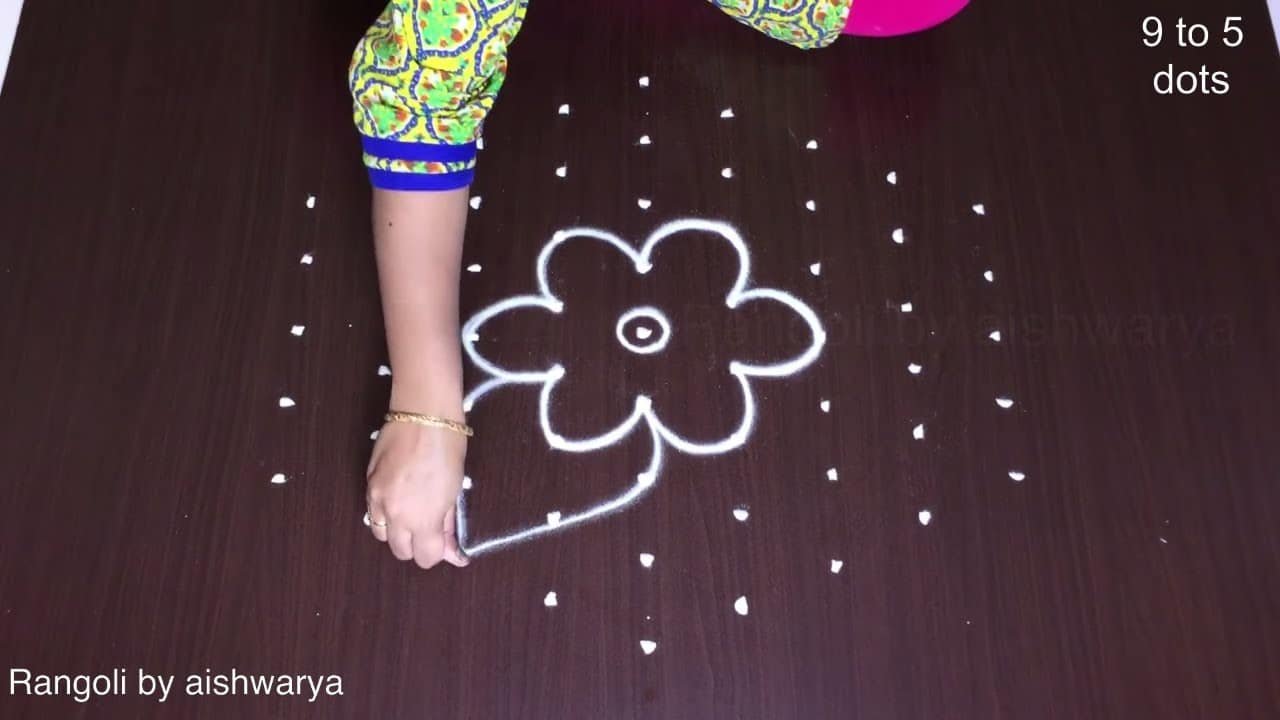
Definition
The mandala motif is the circle built into a world: concentric rings of petals, geometry, and ornament organised in radial symmetry around a marked centre. The Sanskrit word means circle, disc, complete whole — and the form delivers the name: every element at a measured station, every station related to the centre, complexity held in perfect balance. In rangoli it is the summit of radial composition, the form the largest ceremonial designs most often take.
The mandala is less a single motif than a way of composing motifs: lotuses, stars, chakras, vines, and dots all serve as its rings. What makes a design a mandala is the discipline — concentric, radial, centred.
History
Circular sacred diagrams run deep in the subcontinent’s traditions — Vedic, Buddhist, and Jain practice all developed them, and temple architecture laid mandala logic into floor plans themselves. The form travelled with Buddhist art across Asia and, in the modern era, across the world: “mandala” is now a global word for centred radial design, one of India’s most widely adopted artistic exports. Painted ceilings, manuscript diagrams, textile medallions, and ritual drawings carry the lineage; the threshold arts give it a daily, drawable form.
The research literature returns to mandala-type figures repeatedly, because they demonstrate rule-governed complexity: simple relationships — equal angles, proportional rings, rotational repetition — applied with precision until a rich whole emerges. Traditional practitioners work those rules by eye and memory; the drawn result is geometry without instruments at its most ambitious.
Description
Every mandala begins at the centre: a single dot, then rings developed outward — circles, polygons, petal bands, spoke systems — each layer keeping the established angular divisions. Grid-based practice lays concentric dot rings first; freehand practice divides by eye. The standard families include floral mandalas of layered petals, dot-grid mandalas on counted rings, lotus mandalas of concentric eight-petal orders, and festival mandalas that fill courtyard-scale circles with colour.
The construction rewards patience arithmetic: because each ring multiplies the stations of the last, a mandala’s final complexity vastly exceeds the difficulty of any single step. The centre does the governing — lose it and the rings drift; hold it and hundreds of elements land true. Practitioners give the first dot the care the whole design will inherit.
Cultural Context
The mandala’s readings gather around one idea: order radiating from a shared centre. Traditions have used the form to figure the cosmos, the mind, and sacred space — diversity organised by relation to a common origin, complexity that is harmony rather than crowd. The senses live in the traditions that draw it; the drawn fact is concentric geometry, and the fact itself carries the argument: from one point, a world, in balance.
Its contemporary life is unusually broad — architecture, education, therapeutic art, design theory — and perception research offers a footnote the practice discovered first: strongly symmetric radial patterns read as order and calm even at great richness. The mandala is the tradition’s proof that discipline and abundance are not opposites.
Regional Variations
Mandala composition spans every tradition: the southern grid arts build it on counted dot rings, the northern and western festival styles fill it with colour, the ceremonial diagram traditions keep its strictest ritual forms. Scale runs from hand-span household circles to courtyard designs drawn by teams — the same grammar throughout, rings around a governed centre.
Related Topics
The mandala’s building blocks have their own entries: the Lotus and Star that form its rings, the Chakra it develops from, the Dot Grid that stations it; its structural family is the Radial Structure; the centre it grows from is the dot whose story belongs to Pulli Kolam.
Gallery
References
- Vijaya Nagarajan, Feeding a Thousand Souls: Women, Ritual, and Ecology in India — An Exploration of the Kōlam, Oxford University Press, 2018.
Further Reading
- Marcia Ascher, Mathematics Elsewhere: An Exploration of Ideas Across Cultures, Princeton University Press, 2002.
This entry publishes at Evidence Level E1: common knowledge within the tradition, anchored to a verified standard reference.
Cite this entry: “Mandala.” Rangoli Encyclopedia, Rangoli Designs, https://rangolidesigns.net/encyclopedia/mandala/ — a permanent URL under the encyclopedia’s stable-identity policy. Entry last reviewed 2026-07-28.