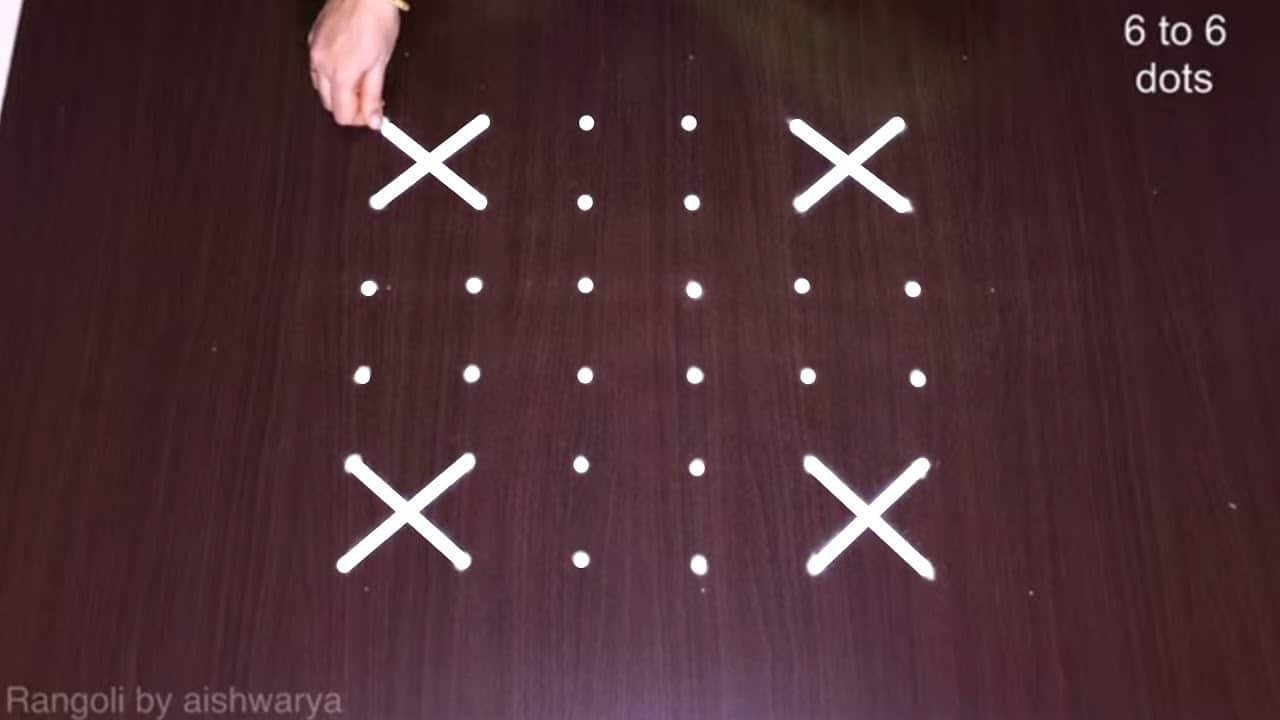
Every rangoli, however elaborate, decomposes into a handful of elements: dots, lines, circles, squares, triangles, spirals. The tradition’s entire visual wealth — the peacocks and chariots, the layered mandalas, the festival compositions that fill a courtyard — is built from this small alphabet, combined and recombined under a discipline of balance. This essay describes the alphabet and its grammar; the motifs those elements become have a chapter of their own.
An alphabet of six
The dot is the origin. In the southern grid traditions it is literally the first mark — laid down in counted rows before any line exists — and everywhere it is the anchor: a centre declared, a rhythm set, a flower’s heart. Placement is its whole craft; a grid true at the start is the difference between a design that closes and one that drifts.
The line carries movement — straight for steadiness and structure, curved for grace, and in the southern traditions looped endlessly around dots until the path returns to its beginning. The circle encloses: holding one distance from its centre, it is complete from every direction, the natural container for radial work. The square grounds: where the circle suggests continuity, the square’s right angles give a composition something to stand on, which is why frames, foundations, and grid boundaries so often take its form. The triangle points: alone among the basic forms it has direction, sending the eye where its vertex aims; repeated it locks into borders and lattices, and rotated against itself it becomes the repertoire’s stars. The spiral grows: its radius changes as it turns, expansion with continuity, and artists reach for it when rigid geometry needs softening — a feather’s eye, a flower’s centre, a corner that must flow into its neighbour.
Roles, not just shapes
In composition, each element takes a role. Geometry provides the structure; floral and figurative motifs bring softness and life; directional forms create movement; the border establishes order; and the ground left open lets everything breathe — the principle the tradition honours enough that this encyclopedia gives empty space an essay of its own. A design reads clearly when the roles are cast: structure, softness, movement, frame, and rest all present, none doing another’s job.
Relationships make meaning
Elements and motifs take significance from their neighbours. A lotus among wave lines reads as a pond; a peacock beneath a flowering branch becomes a landscape; lamps ringed by a garland turn a geometric base festive. These are not fixed formulas — the tradition keeps no dictionary that assigns one meaning per combination. Artists arrange by region, occasion, and eye, and the same pairing can be pure ornament in one courtyard and quiet homage in the next. What holds constant is the principle: the dialogue between motifs matters more than any single form, which is why practised viewers recognise a regional style less by its symbols than by how familiar elements are combined.
Balance, the working principle
Ask what makes a composition succeed and the tradition’s working answer is a set of tensions held: density against openness, symmetry against variation, simplicity against detail, movement against stability, repetition against surprise, ornament against restraint. No pole wins outright. Symmetry is the strongest organiser — the mirror, rotation, and repetition structures described in The Four Symmetries — yet practitioners deliberately admit small variations where space or occasion asks, and the balance survives because it was never mechanical duplication to begin with. The finest designs look effortless precisely because every element supports the others.
Colour joins the composition
Colour enters the same grammar. Practised work builds a palette the way it builds a drawing: dominant colours to lead, supporting colours to carry, accents to punctuate, and unfilled ground as the palette’s rest. Each choice does compositional work — emphasising the centre, separating adjacent motifs so each stays legible, warming a border, strengthening a symmetry by repeating along its axes, guiding the eye along the path the line began. Experienced artists settle this balance before refining detail, so no section can outshout the rest. The palette is also a regional voice: some traditions favour saturated multicolour, others restrained earth tones — and the austere case proves the whole argument, for the all-white designs of the daily threshold hold attention with nothing but line, spacing, and balance.
A small vocabulary, without end
The alphabet is small and the grammar is strict, and the tradition’s diversity comes precisely from that. A compact set of elements, held in balance, generates designs without repetition across regions and generations — the same combinatorial abundance the mathematics of pattern makes exact in Seventeen Ways to Repeat. Nor are the principles parochial: balance, repetition, hierarchy, and negative space are the fundamentals of any design education, reached here not through theory but through generations of practice on the morning threshold.
References
- Vijaya Nagarajan, Feeding a Thousand Souls: Women, Ritual, and Ecology in India — An Exploration of the Kōlam, Oxford University Press, 2018.
- Marcia Ascher, Mathematics Elsewhere: An Exploration of Ideas Across Cultures, Princeton University Press, 2002.
Further Reading
- Kiwamu Yanagisawa & Shojiro Nagata, “Fundamental Study on Design System of Kolam Pattern”, Forma 22, 2007.
This entry publishes at Evidence Level E2: its claims rest on at least two independently verified sources.
Cite this entry: “The Elements of Design.” Rangoli Encyclopedia, Rangoli Designs, https://rangolidesigns.net/encyclopedia/elements-of-design/ — a permanent URL under the encyclopedia’s stable-identity policy. Entry last reviewed 2026-07-29.