Definition
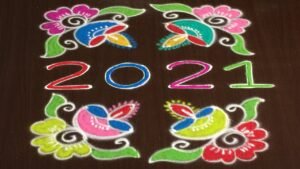
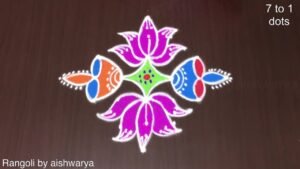
The diya motif draws the traditional Indian oil lamp — a small bowl with a curved spout carrying a wick, its flame rendered as an upward-pointing teardrop. It is rangoli’s image of light itself, and one of the practice’s most frequently drawn objects: a single lamp at the centre of a modest design, pairs at an entrance, rings of lamps around a festival composition.
The object behind the motif is ancient and essentially unchanged: a shallow vessel of clay, brass, bronze, or stone holding oil or ghee and a cotton wick. The form was perfected early — shallow bowl conserving fuel, curved lip supporting the wick, broad stable base — and its long stability is one reason the drawn version is recognisable everywhere at any degree of stylisation.
History
Oil lamps run through the subcontinent’s material record with rare continuity: excavated terracotta lamps from ancient settlements, sculpted and bronze-cast lamps of the temple traditions, the monumental tiered lamps of southern temple courtyards, lamps in manuscript illustration and architectural ornament. Lighting a flame after sunset is among the oldest ordered acts of household life, and the lamp accumulated its meanings across that whole history — long before floor art adopted its image.
Within rangoli the drawn lamp and the real one work side by side. In festival practice, physical diyas are frequently placed upon or beside the drawn design — the motif and its object completing one another, powder providing the geometry and flame providing the life. No other rangoli motif routinely appears together with the thing it depicts.
Description
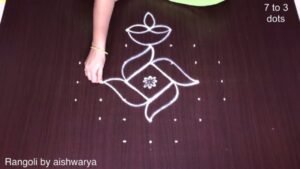
The drawn diya resolves into two parts with opposite characters: the bowl — stable, symmetric, grounded — and the flame — elongated, gently curved, upward-moving. Artists exploit the contrast: the vessel is drawn with geometric firmness, the flame with a freer hand, and the pairing of permanence below and movement above gives even a five-stroke lamp its expressive charge.
Standard arrangements include the single lamp of personal devotion; the balanced pair flanking an entrance or a central motif; circular arrangements — many lamps rayed symmetrically around a lotus or geometric centre; running lamp borders framing large ceremonial designs; and floating-lamp compositions recalling lamps set on rivers and temple ponds. The motif’s compact footprint and vertical accent make it unusually easy to place — it fits wherever the composition needs a point of warmth.
Cultural Context
The lamp’s attributed meanings radiate from one metaphor: light as knowledge. In the philosophical register, darkness stands for ignorance and confusion, light for understanding, clarity, and truth; lighting a lamp enacts the preference. The devotional register runs parallel: a flame lit before worship marks divine presence, purity, and auspicious beginning, and many households light a diya before or beside the morning’s drawing. A third, quieter sense belongs to teaching — one flame lights countless others without diminishing, the tradition’s favourite image for knowledge shared. The drawn lamp carries all three senses, context selecting among them.
The motif’s great occasion is Diwali, the festival of lights, when rows of real lamps line homes and streets and the drawn lamp fills the season’s rangoli. But the diya is not seasonal property: it attends weddings, pujas, remembrances, and openings across traditions — Buddhist, Jain, and Sikh practice all keep ceremonial lamps — making it one of the most widely shared emblems in Indian visual culture.
Regional Variations
Every regional tradition draws the lamp: coloured festival diyas in the north and west, line-drawn lamps in southern kolam and muggulu, painted lamps in the eastern rice-paste arts, and lamp motifs within ceremonial aipan and chowk compositions. Regional accents change the ornament — the essential bowl-and-flame reads identically everywhere, which is precisely what a symbol of shared light should do.
The southern calendar gives the lamp a second great season: Karthigai Deepam, the Tamil festival of lamps, when rows of diyas and lamp-centred kolams answer the month’s early dark. Fuel follows region and rite — sesame, mustard, or coconut oil, or ghee — and contemporary design has carried the motif far beyond the threshold: logos, stamps, public art, and digital work all reach for the bowl-and-flame when they need an image of hope that every viewer already knows how to read.
Related Topics
The lamp’s constant companions are the Lotus it often crowns and the Kalash it flanks; its great festival is Diwali; its seasonal southern counterpart is the lamp festival Karthigai Deepam.
Gallery
References
- Vijaya Nagarajan, Feeding a Thousand Souls: Women, Ritual, and Ecology in India — An Exploration of the Kōlam, Oxford University Press, 2018.
Further Reading
- Jyotsna Kilambi, “Toward an Understanding of the Muggu: Threshold Drawings in Hyderabad”, RES: Anthropology and Aesthetics 10, 1985.
This entry publishes at Evidence Level E1: common knowledge within the tradition, anchored to a verified standard reference.
Cite this entry: “Diya.” Rangoli Encyclopedia, Rangoli Designs, https://rangolidesigns.net/encyclopedia/diya/ — a permanent URL under the encyclopedia’s stable-identity policy. Entry last reviewed 2026-07-28.